Introduction
Why is there so much focus on AI and semiconductors? Not just at Capital Dynamics and i Capital, but on a national and global scale too.
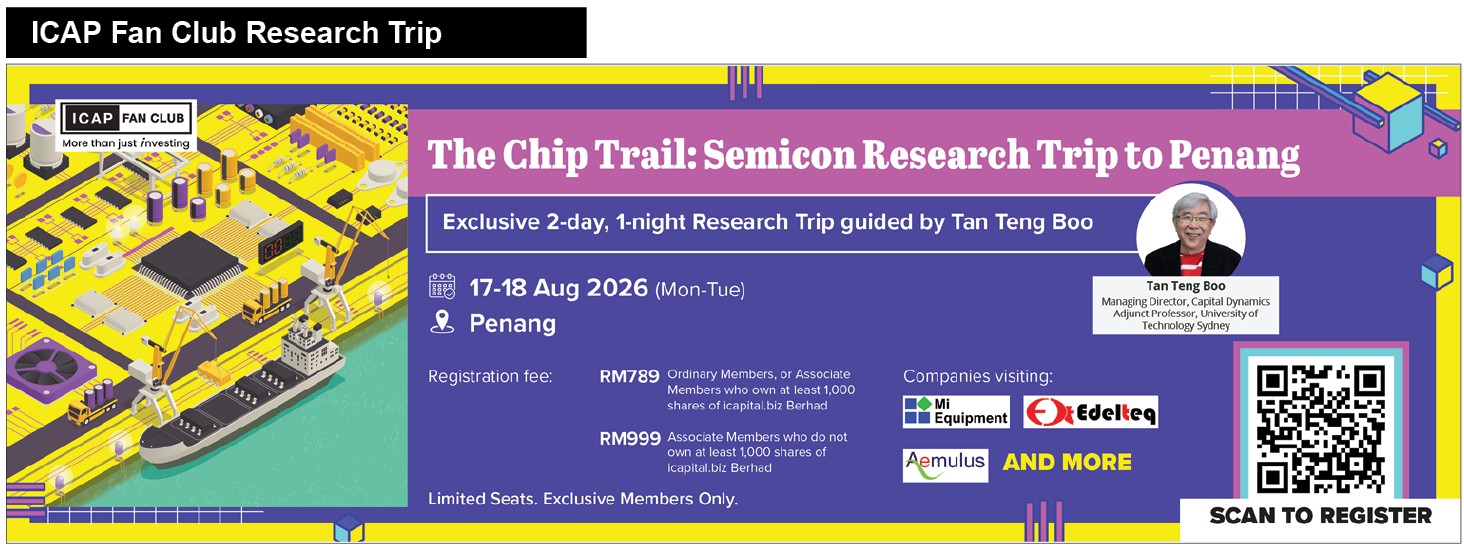
[1] At Capital Dynamics and i Capital, we have put much effort and attention into researching AI and semiconductors while making the two rapidly-evolving industries accessible to the average Malaysian mind. On Capital Dynamics’ YouTube channel, we have since early 2026 published a special ICAPSEMI series. During the 2025 Investor Day, a big chunk of the event was dedicated to explaining semiconductors and the investment opportunities they offer. We have also launched a new portfolio in i Capital on 4 Dec 2025 called “ICAPSEMI”. Many ICAP Fan Club activities concern the semiconductor sector, the latest being the SEMI-chat held on 11 Jul 2026 in Ipoh. The next activity is a 2-day research trip to Penang on 17 and 18 Aug 2026, focusing on the semiconductor supply chain. Even for the staff recruitment of Capital Dynamics at its Kuala Lumpur, Hong Kong, Sydney and Shanghai offices, AI and semiconductor is our main attention.
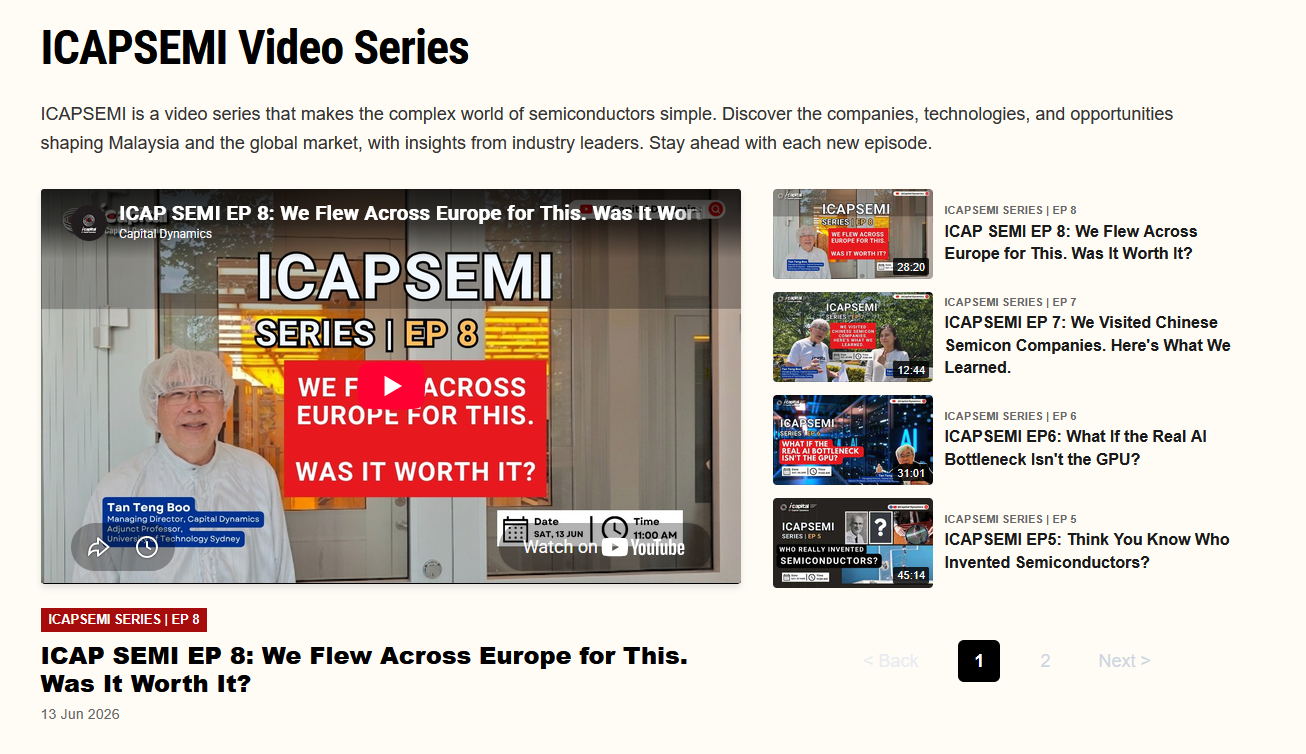
Source: icapsemi.com and Our YouTube ICAPSEMI series
[2] On a national scale, as i Capital has laid out extensively, the present Malaysian government has rightfully put top priority on the further developing and strengthening Malaysia’s semiconductor ecosystem. Since the May 2024 launch of Malaysia’s National Semiconductor Strategy by prime minister Anwar Ibrahim, for the first time in Malaysian contemporary history, the country is getting her national priorities right.
Why so much focus on semiconductors by prime minister Anwar?
Fundamentally, the success or failure of Malaysia’s National Semiconductor Strategy will decide the type of future Malaysians, especially those below their Thirties and Forties, will face — one brimming with hope and optimism or one drowning in despair and desperation. The success or failure of Malaysia’s National Semiconductor Strategy essentially decides whether Malaysia stagnates at the Middle-Income Trap or not. It is that simple. It is that crucial.
[3] Globally, one discerns multiple reasons for the overwhelming focus on AI and semiconductors in recent years. One can see this in both traditional and social media, in the economic policies of many countries, especially the United States and China — and in innumerable stock markets.
The question, however, remains: why?
As Tan Teng Boo sees it, there are four main factors for this frenzied focus on AI and semiconductors.
Maturing AI
First, and probably the most important reason, is the stage with which artificial intelligence has advanced to in recent years. AI did not reach its current stage of advanced development overnight.
The popular narrative is that the earliest substantial work in the field of artificial intelligence was done in the mid-20th century by the British mathematician Alan Mathison Turing. In 1935, Turing described an abstract computing machine consisting of a limitless memory and a scanner that moves back and forth through the memory, symbol by symbol, reading what it finds and writing further symbols. The actions of the scanner are dictated by a program of instructions that also is stored in the memory in the form of symbols. This is Turing’s stored-program concept, and implicit in it is the possibility of the machine operating on, and so modifying or improving, its own program. Turing’s conception is now known simply as the universal Turing machine. All modern computers are in essence universal Turing machines (https://www.britannica.com/science/history-of-artificial-intelligence).
As with nearly all Western narratives, scientific and technological inventions and achievements are forged in the crucible of the West; first Europe and UK and then, the United States. From their point of view, the history of civilisation is that short. However, if they drop their Western myopism and sense of superiority complex, they would discover that the origin of modern computing and AI goes back 3,000 odd years, all the way back to the time of the I Ching (The Book of Changes).
As with many improvements in human civilisation, progress builds whether directly or indirectly on preceding advancements or discoveries. Our article on I Ching and Leibniz and George Boole lays out the fascinating, unsung and unnoticed connection between I Ching and computers and AI.
Fast forward to now: a game-changer event in present day AI occurred in Jun 2020, when OpenAI introduced GPT-3, a significant leap forward in LLM capability. Bearing 175 billion parameters, GPT-3 was the largest language model ever created at that time. It demonstrated unprecedented versatility, capable of performing a wide range of tasks with little to no task-specific training data. GPT stands for generative pre-trained transformers.
One of GPT-3’s most remarkable features was its ability to perform few-shot learning. Unlike previous models that required extensive fine-tuning for specific tasks, GPT-3 could generate accurate responses based on just a few examples. This made it more than a mere jack of all trades, allowing it to excel in tasks ranging from coding to creative writing, translation, and even conversational AI.
GPT-3 quickly found a place in various industries. It was used to power chatbots, assist in content creation, generate code snippets, and even produce creative works like stories and poetry. Its ability to understand and generate text in multiple languages also made it valuable for translation and localization tasks.
On 20 Nov 2022, OpenAI released the generative artificial intelligence chatbot ChatGPT to the public. The chatbot was more sophisticated than popular predecessors found in Apple’s Siri, Amazon’s Alexa, and Google Assistant.
ChatGPT built on the start-up’s seven years of development work on large language models (LLMs), computer programs that learn from vast amounts of text to read, write and converse in natural language. As a “spin-off” of GPT-3, ChatGPT harnessed this technology through a conversational chatbot using GPT-3.5.
ChatGPT accelerated the AI boom, an on-going phase marked by rapid investment and public attention towards AI across the world, particularly pronounced in the United States and China. ChatGPT was quickly adopted, reaching 100 mln monthly active users two months after its release and 900 mln weekly active users in Feb 2026.
Over the last few years, the world economy has been massively shaken up by the unprecedented rapid developments in AI. As a result, there is now an AI ecosystem for the first time. It is not confined to just the fast changing capabilities and rapidly widening range of the models coming out of the United States and China. The AI ecosystem is made up of many layers of supporting ecosystems which, due to the new demands of AI, have been substantially disrupted. New semiconductors are needed, new chip manufacturing equipment and packaging methods are needed, new products and services are being introduced and more.
An excellent illustration of the new demands effected by AI is global semiconductor sales (figure 1). Since 2023, global semiconductor sales have grown at a pace that has never been seen before, and are accelerating still to heights even further from our imagination.
In the investment world, something huge has been afoot as well. On 31 Jan 2020, Nvidia’s stock price closed at US$5.88. By 1 Dec 2021, it had rallied to US$28.75, a surge many thought was the making of an AI bubble. On 21 Nov 2022, a day after ChatGPT was announced, Nvidia’s closing price was US$12.86, a plunge from its Dec 2021 peak. They say hindsight is 20/20 vision. Anyone buying Nvidia’s stock then would have made a bundle by now — it hit US$234.26 on 15 May 2026. Again, talk of the terrible AI bubble now abounds.
A good look at the prices of some semiconductor stocks (figures 2 to 6), which have gone parabolic, would explain why talks of an AI bubble have re-emerged.
Is AI a bubble? Or a real revolution? Where are we now?
What is happening to AI and the semiconductor ecosystem must be placed within the context of US-China relations, especially since Trump 1.0. At the centre of US-China rivalry is semiconductors, an arena made more complicated and less predictable by developments in the AI ecosystem. Developments in semiconductor and AI ecosystems, as previously explained, are now deeply intertwined.
US attacks on China
Trump 1.0 (2018–2021)
The first Trump administration’s technology-related trade maneuvers began with the tariffs imposed under the Section 301 investigation. Following the Section 301 investigation initiated in 2017 and then the 2018 release of its findings, the United States imposed tariffs on a broad range of Chinese imports, including products connected to the semiconductor supply chain.
Source: https://ustr.gov/sites/default/files/Section%20301%20FINAL.PDF
One of the earliest major enforcement moves involved ZTE, a Chinese telecommunications company that was accused of violating US sanctions on Iran and North Korea. In April 2018, the Bureau of Industry and Security (BIS) activated a Denial Order prohibiting US companies from supplying items subject to the Export Administration Regulations (EAR) to ZTE, effectively cutting the company off from US semiconductors, software, and other technology.
The most consequential measure came in May 2019, when Huawei Technologies and 68 non-U.S. affiliates were added to the Entity List. On 1 Dec 2018, Meng Wanzhou, CFO and daughter of Huawei’s founder Ren Zhengfei, was detained upon arrival at Vancouver International Airport by Canada Border Services Agency officers for questioning, which lasted three hours (In Aug 2021, the Canadian extradition judge questioned the regularity of the case and expressed great difficulty in understanding how the Record of Case presented by the US supported their allegation of criminality.) Huawei was then one of the world’s leading technology companies and became, in late 2018, the smartphone manufacturer after Apple to commercialize a handset that used a 7-nanometre processor designed by its subsidiary HiSilicon and fabricated by TSMC. Officially, the US government cited fraud allegations and sanctions violations involving Iran, while broader national security concerns centred on Huawei’s growing role in global 5G infrastructure and potential surveillance risks. The designation required exporters to obtain a license before supplying Huawei with items subject to the US Export Administration Regulations.
Source: https://www.bbc.com
Under the de minimis rule, foreign-made products containing less than 25% controlled US content generally fell outside US export controls. Washington closed this loophole in 2020 by expanding the Foreign Direct Product Rule (FDPR), requiring a US license for semiconductors produced anywhere in the world using specified US software or manufacturing equipment when destined for Huawei in particular. Huawei was TSMC’s second-largest customer at the time; TSMC stopped accepting new Huawei orders before the rule took full effect.
In Dec 2020, Semiconductor Manufacturing International Corporation (SMIC), China’s largest contract chipmaker, was added to the Entity List because of concerns over military end-use, significantly restricting its access to advanced semiconductor manufacturing equipment. Around the same period, the United States also pressured the Dutch government to not approve exports of ASML’s extreme ultraviolet (EUV) lithography systems, effectively preventing China from obtaining the only commercially available equipment capable of manufacturing leading-edge semiconductor nodes.
The Biden Administration (2021–2025)
The Biden administration retained the Trump-era export control framework but significantly broadened its scope from firm-specific restrictions to comprehensive, ecosystem-wide controls targeting China’s semiconductor and artificial intelligence capabilities. The turning point came on 7 Oct 2022, when the US BIS issued the most sweeping semiconductor export controls since the Cold War. The measures covered four principal areas:
- Advanced AI chips: Export licenses, subject to a presumption of denial, became mandatory for advanced computing chips destined for China, effectively preventing exports of Nvidia’s A100 and H100 graphics processing units (GPUs), which at the time represented the industry standard for AI model training.
- Semiconductor manufacturing equipment: BIS imposed restrictions on equipment used to manufacture advanced logic chips at 16/14-nanometre nodes and below, DRAM memory at 18nm half-pitch or below, and NAND flash memory with 128 layers or more.
- Extended jurisdiction: A new Footnote 4 designation expanded the FDPR to 28 Chinese entities, extending US export controls to foreign manufacturers, including TSMC, Samsung, and other overseas foundries even where U.S.-origin content would otherwise fall below traditional de minimis thresholds.
- US persons rule: US citizens, permanent residents and entities were prohibited from supporting China’s advanced semiconductor development without prior authorization, prompting numerous American engineers and executives to resign from Chinese semiconductor firms.
Beyond unilateral measures, the Biden administration coordinated closely with key allies possessing critical semiconductor technologies. The Netherlands, home to ASML, the world’s sole producer of EUV lithography systems, and Japan, home to Tokyo Electron and other major semiconductor equipment manufacturers, gradually aligned their export control regimes with that of the United States.
Domestically, the CHIPS and Science Act, signed into law in Aug 2022, allocated US$52.7 bln to strengthen US semiconductor manufacturing and research while prohibiting recipients of federal subsidies from significantly expanding advanced semiconductor production capacity in China for a period of ten years. By 2023, both Japan and the Netherlands had introduced complementary export restrictions, although implementation timelines differed, and ASML continued exporting certain deep ultraviolet (DUV) lithography systems that remained outside EUV-specific controls because of China’s importance as one of its largest markets. Meanwhile, the proposed Chip 4 Alliance, bringing together the United States, Japan, South Korea and Taiwan, made only limited progress due to differing strategic priorities, particularly South Korea’s heavy commercial dependence on the Chinese semiconductor market.
Chinese demand for advanced AI chips remained strong. To comply with the Oct 2022 rules, Nvidia introduced its A800 and H800 GPUs, engineered to hover just below BIS performance thresholds while retaining much of the functionality required for AI training. BIS subsequently closed this loophole through updated export controls issued in Oct 2023, replacing the earlier performance threshold with broader measures covering total processing performance and introducing a zero percent de minimis threshold for advanced lithography equipment, thereby bringing virtually any qualifying foreign-produced equipment incorporating US technology under U.S. jurisdiction. These revisions were subsequently matched by tighter Dutch and Japanese restrictions on advanced DUV lithography equipment.
The Biden administration introduced its final and most comprehensive package of semiconductor export controls on 2 Dec 2024. BIS added 140 entities to the Entity List, including companies based in Japan, South Korea, and Singapore. The package also imposed controls on high-bandwidth memory (HBM), a critical component used in advanced AI accelerators such as Nvidia’s H100 GPUs and Huawei’s Ascend processors, while introducing Footnote 5, which further expanded the scope of the FDPR. Finally, BIS announced the AI Diffusion Rule, establishing a three-tier framework that classified countries according to their access to advanced AI computing technologies: unrestricted access for close allies (Tier 1), capped access for selected partners (Tier 2), and near-total restrictions for China, Russia, and other designated countries (Tier 3).
Trump 2.0 (2025–Present)
Under the second Trump administration, US semiconductor export controls remained in place but were increasingly used alongside broader trade negotiations. In early 2025, the BIS expanded the Entity List by adding 42 Chinese entities, many linked to advanced semiconductor procurement networks. The administration also imposed new license requirements on the world’s three leading electronic design automation (EDA) software providers — Synopsys, Cadence Design Systems, and Siemens EDA, reflecting the strategic importance of EDA software in advanced integrated circuit design. In May 2025, BIS announced that Huawei’s Ascend 910B and 910C AI accelerators were believed to have been developed using technology subject to U.S. export controls, while Samsung Electronics and SK Hynix reportedly lost aspects of the preferential treatment previously granted to their China-based fabrication facilities under the Validated End User (VEU) programme.
The most significant development concerned Nvidia’s H20 graphics processing unit (GPU), a reduced-performance chip specifically designed for the Chinese market to comply with earlier export restrictions. In Apr 2025, BIS introduced new licensing requirements for H20 exports to China, effectively suspending shipments despite strong demand from major Chinese cloud service providers, including ByteDance, Alibaba, Baidu, and Tencent. China accounted for approximately 13% of Nvidia’s total revenue, making the Chinese market strategically important despite tightening export controls. Following renewed US-China trade negotiations, the administration relaxed certain licensing restrictions during Jul 2025, allowing limited H20 exports to resume under revised licensing arrangements.
At approximately the same time, BIS withdrew the license requirements previously imposed on EDA software exports to China. The reversal coincided with trade negotiations held in Geneva, where China agreed to resume exports of selected rare-earth magnets while Chinese regulators subsequently approved Synopsys’ proposed US$35 bln acquisition of Ansys.
Taken together, these developments suggest that US export controls have gradually converged on six critical chokepoints within the semiconductor and AI supply chains.Table 1 summarizes how effective controls at each of these points have been so far.
| Critical Supply Chain Node | Control Mechanism | Key Companies Affected | Effectiveness |
|---|---|---|---|
| EUV Lithography | Informal US pressure on the Netherlands; FDPR | ASML (sole supplier) | High. China has no EUV access. |
| Advanced AI GPUs | BIS export controls; entity-specific rules | Nvidia, AMD, Intel | Partial. China stockpiled chips before 2022. |
| Semiconductor Manufacturing Equipment | Equipment-focused FDPR; allied coordination | Applied Materials, Lam Research, Tokyo Electron, ASML | Moderate. DUV gaps remain. |
| High-Bandwidth Memory (HBM) | Dec 2024 BIS rule; VEU revocations | SK Hynix, Samsung, Micron | Emerging. Enforcement still developing. |
| EDA Software | BIS licensing requirement (May 2025) | Synopsys, Cadence, Siemens EDA | High potential. |
| US Person Support | Oct 2022 restrictions on US nationals | Engineers, consultants | Significant. |
Source: https://www.channelnewsasia.com
Click to see the sources
- i Capital and Capital Dynamics
- https://ustr.gov/sites/default/files/Section%20301%20FINAL.PDF
- https://www.federalregister.gov/documents/2019/05/21/2019-10616/addition-of-entities-to-the-entity-list
- https://crsreports.congress.gov/product/pdf/IF/IF11283
- https://www.ecfr.gov/current/title-15/subtitle-B/chapter-VII/subchapter-C/part-734
- https://www.federalregister.gov/documents/2020/08/20/2020-18213/addition-of-certain-entities-to-the-entity-list-revision-of-entry-on-the-entity-list-and-removal
- https://www.federalregister.gov/documents/2022/10/13/2022-21658/implementation-of-additional-export-controls-certain-advanced-computing-and-semiconductor
- https://www.congress.gov/bill/117th-congress/house-bill/4346
- https://www.federalregister.gov/documents/2023/10/25/2023-23055/export-controls-on-advanced-computing-items-updates-and-corrections
China Fights Back
To maintain its technological leadership and weaken China, tireless rival the United States is resorting to a two-pronged strategy: (i) ramping up investments in scientific research and the production of critical goods; (ii) denying China access to Western advanced semiconductor and other critical technologies. Over the years, the United States government has introduced measures to block China’s access to advanced technologies and equipment vital for the development of advanced chips, AI, supercomputers, and other critical technologies, as detailed in US Attacks on China. China, not quite a wolf but not a lamb either, has fought back. We list below some key counter-measures.
1990 to 2004
Throughout the 1990s, the Chinese government pursued partnerships with foreign companies to accelerate progress. Beginning with the eighth FYP (1991–95), China tried to develop Huajing (operator of Wuxi Factory No. 742) into a leading IDM, endowing it with RMB 2 billion and negotiating a joint-venture relationship with Lucent Technologies to facilitate technology transfer. During the Ninth FYP (1996–2000), Huahong, in partnership with NEC, successfully manufactured DRAM chips. In 2000, the Semiconductor Manufacturing International Corporation (SMIC) was established in Shanghai.
China’s State Council issued “Document No. 18” in 2000, titled “Several Policies to Encourage the Development of Software and Integrated Circuit Industries”. This policy aimed to make China a leading IC design and manufacturing base by 2010, enough to meet most domestic demand and support significant exports. It provided significant tax incentives, including a value-added tax reduction from 17% to 3% for domestically produced chips, income tax holidays for qualifying IC and software firms, tariff exemptions on imported production equipment, duty-free imports of raw materials, and eased conditions for foreign investment in the sector.
2005 to 2013
In 2005, China’s State Council issued the “National Medium- and Long-Term Science and Technology Development Plan Outline” for the 2006–2020 period (MLP). The MLP calls for China to become an “innovation-oriented society” by the year 2020, and a world leader in science and technology by 2050. It officially elevated the status of integrated circuits to core strategic technology for national development.
Many of Document No.18’s tax benefits were due to expire at the end of 2010. In 2011, the State Council issued Document No. 4, titled “Certain Policies for Further Encouraging the Development of the Software Industry and Integrated Circuit Industry,” renewing and expanding earlier incentives in line with the 12th Five-Year Plan.
2014 to 2020
In June 2014, the Chinese government published the Guidelines to Promote National Integrated Circuit Industry Development, with the goal of establishing a world-leading semiconductor industry in all areas of the integrated circuit supply chain by 2030. The document laid the foundation for the Made in China 2025 plan unveiled in 2015, which set the goal of meeting 70% self-sufficiency in semiconductors by 2025. In 2019, the goal was revised upward to meet 80% of semiconductor demand with domestic production by 2030. To implement its semiconductor plan, the Chinese government created the China Integrated Circuit Investment Industry Fund (also known as the Big Fund) in 2014 to direct capital to the domestic semiconductor industry, building out a domestic infrastructure of equipment and materials suppliers. Big Fund was endowed with US$150 billion in funds from the central and provincial governments.
Spanning three phases, each phase of the Big Fund has focused on a different segment of the semiconductor supply chain. The first phase directed resources to semiconductor fabrication and upstream chip design capabilities. The second phase, launched in 2019, targeted apparatus such as etching machines and testing and cleaning equipment, as well as materials like photoresists and specialty gases. The third phase will invest mainly in chip-making equipment, particularly for advanced chips — see table 2 for details.
| Phase 1 | Phase 2 | Phase 3 | |
|---|---|---|---|
| Date of establishment | Sep 2014 | Oct 2019 | May 2024 |
| Registered capital | RMB98.7 billion | RMB204.2 billion | RMB344 billion |
| Key elements | Focus on IC manufacturing, semiconductor design, packaging and testing, and semiconductor equipment and materials. | Focus on more specialized segments of supply chain, e.g. etching machines and testing
equipment. Greater emphasis on achieving self-reliance in the supply chain. More investment in areas such as electronic design automation (EDA). |
Focus on equipment for chip manufacturing to reduce dependence on Western companies such as ASML,
and to develop indigenous industry. Development of large semiconductor manufacturing plants and components for HBM; priority given to advanced chip tech for AI and disruptive emerging technology such as chiplets. |
Source: https://www.scmp.com
The scale of investment is remarkable. According to the Information Technology and Innovation Foundation, China has invested the rough equivalent of the US CHIPS Act in its semiconductor industry virtually every year since 2014. In 2025, the Chinese semiconductors market recorded a revenue of US$221.5 bln, representing a compound annual growth rate (CAGR) of 11.7% between 2020 and 2025. China held a share of 50.6% in the Asia-Pacific semiconductors industry in 2025. According to the China Semiconductor Industry Association, the country’s integrated circuit industry sales reached RMB1.73 trillion (approximately US$241 bln) in 2025. This growth was broadly distributed across the value chain: the design segment grew 24.8% to RMB 826.1 bln, manufacturing grew 17.1% to RMB 522.6 bln, and packaging and testing grew 15.2% to RMB 384.4 bln.
In 2020, the State Council issued the “Notice on Several Policies to Promote the High-Quality Development of the Integrated Circuit Industry and Software Industry in the New Era” (Document No. 8), which exempted qualifying IC manufacturers operating advanced nodes from corporate income tax for up to ten years. Since 2023, eligible IC enterprises and manufacturers of high-end industrial equipment have been permitted to deduct 220% of qualifying R&D expenditure (versus 200% for ordinary high-tech enterprises), and IC manufacturers below the 130-nm node have been granted extended loss-carry-forward periods. On top of these national measures, local governments also provided incentives and subsidies to semiconductor companies.
2021 to present
The 14th Five-Year Plan (2021-2025) named semiconductors and other frontier fields as core strategic technology priorities requiring a “new whole-of-nation system” (新型举国体制) mobilization of resources. Supporting measures include:
- Enterprise-Led Innovation: Strengthening the role of enterprises in innovation and promoting deep integration of industry, academia, research, and application.
- Capital Market Support: Smoothing domestic listing and financing channels for technology-based enterprises, specifically by enhancing the “hard technology” (硬科技) characteristics of the STAR Market.
- Reformed Project Management: Implementing flexible funding and project management mechanisms, such as the “open competition” (揭榜挂帅) system, to give research units and personnel greater autonomy in tackling critical tech hurdles.
- Talent Pipeline: Cultivating high-level strategic scientists, leading tech talents, and large pools of highly skilled engineers to support the semiconductor ecosystem.
- IP Protection: Implementing a robust intellectual property strategy, including faster legislation for new business formats, stricter IP enforcement, and improved mechanisms for researchers to share in the financial rewards of their patented innovations.
14th Five-Year Plan targets the entire value chain of the semiconductor industry:
- Design & Equipment: Accelerating the research and development of domestic integrated circuit design tools (EDA) and key manufacturing equipment.
- Advanced Materials: Developing critical materials, including high-purity target materials and electronic high-purity materials such as photoresists specifically for integrated circuits.
- Manufacturing Processes: Achieving breakthroughs in advanced IC manufacturing processes, as well as specialized processes like Insulated Gate Bipolar Transistors (IGBT) and Micro-Electro-Mechanical Systems (MEMS).
- Next-Generation Semiconductors: Upgrading advanced memory technologies and actively developing wide-bandgap semiconductors, such as Silicon Carbide (SiC) and Gallium Nitride (GaN).
The 15th Five-Year Plan (2026-2030) doubled down on the course of the 14th Five-Year Plan on the semiconductor and AI industry:
- Refine and optimize mature manufacturing processes, and enhance manufacturing capabilities for advanced process nodes.
- Accelerate the development of key equipment, materials, and components, as well as high-performance processors and high-density memory.
- Speed up the quality improvement and upgrading of the wide-bandgap semiconductor industry, and promote the industrialization of ultra-wide-bandgap semiconductors such as gallium oxide and diamond semiconductors.
- Advance technological breakthroughs and applications in areas such as computing-in-memory, three-dimensional (3D) integration, and optoelectronic integration.
- Develop high-performance AI chips and highly available foundational software stacks.
- Accelerate the innovative exploration of foundational AI model architectures.
To boost China’s semiconductor independence, regulators in China restricted the country’s tech companies from using Nvidia’s H20 and RTX Pro 6000D chips for AI last year. Chinese regulators believed that domestic chips had attained performance comparable to or exceeding that of the Nvidia models used in China. Only in early July this year was a limited number of Nvidia’s H200 chips allowed to be imported.
Talent
The 2018 “Artificial Intelligence Innovation Action Plan for Colleges and Universities” was launched to promote the development of AI disciplines and facilitate the establishment of the China RISC-V Industry Alliance. The Ministry of Education implemented innovative talent development models, such as the “One Student, One Chip” program, to strengthen academic disciplines related to integrated circuits.
Source: https://www.frontiersin.org/
In addition to producing home-gown talents, the Chinese government launched many programmes to attract Chinese talents from overseas to return home. These include the Thousand Talents Program, the Young Thousand Talents Program, the Qiming Program, the University “Double First-Class” Initiative, as well as provincial initiatives such as Zhejiang’s Kunpeng Plan. These programmes offered generous financial incentives, research funding, career advancement, and other benefits.
Local Government Initiatives
While central government policies have provided the overarching framework, provincial and municipal governments have emerged as critical actors in the semiconductor ecosystem, competing vigorously to attract and nurture chip enterprises through localized subsidy programs. More than twenty provinces and municipalities, including Beijing, Shanghai, Shenzhen, Hangzhou, Suzhou, and others, have enacted IC-specific support policies. Approximately sixteen cities have introduced subsidy policies for chip design, ten for manufacturing and packaging, and eight for equipment and materials.
The most direct and tangible form of local support is the tape-out subsidy—a cash reimbursement for the costly process of manufacturing prototype chips. Tape-out costs are a formidable barrier for design firms: a 28nm multi-project wafer run can cost RMB300,000-800,000, while a 7nm full-mask tape-out can exceed RMB30 mln. Local tape-out subsidy policies directly reimburse a percentage of these costs, providing immediate liquidity support rather than deferred tax benefits.
The subsidy regimes vary considerably across cities in terms of generosity, caps, and eligibility criteria. Hefei and Shenzhen offer the highest reimbursement rates at 70% for multi-project wafer runs and 50% for full-mask runs, with no process technology thresholds — even 180nm power management chips qualify. Hefei’s caps are particularly generous at RMB5 mln for MPW and RMB10 mln for full-mask runs. Shanghai offers 50% MPW reimbursement and 30% full-mask reimbursement — the highest absolute cap nationally. Beijing offers 50% MPW reimbursement and 30% full-mask, also with a 28nm threshold. Other major semiconductor hubs — Wuxi, Suzhou, Chengdu, and Wuhan — occupy the middle ground with 50% MPW reimbursement and various process thresholds or no process thresholds at all.
Beyond tape-out subsidy, local governments have extended support to EDA tool procurement and IP acquisition. Hefei and Shenzhen’s Nanshan District offer subsidies of RMB10-30 mln for independent EDA and IP development. Shanghai supports enterprises in building EDA development cloud platforms, subsidizing up to 50% of actual procurement costs. Some cities, such as Zhuhai, Wuhan, and Hefei, have established subsidies of 1-3 mln yuan for EDA and IP procurement and leasing.
The aggregate scale of local subsidy growth has been remarkable. Analysis of Shanghai, Suzhou, and Hangzhou’s dedicated integrated circuit support policies over the past fifteen years reveals that maximum subsidy amounts have increased more than tenfold across all three cities, with Shanghai’s ceiling rising from RMB8 mln to RMB100 mln — an increase of more than 12.5 times. During the “15th Five-Year Plan” period beginning in 2026, government subsidy logic has shifted from a narrow focus on manufacturing subsidies toward full-chain precision support encompassing design, equipment, materials, packaging and testing, AI computing power, and automotive-grade chips, covering the entire enterprise lifecycle from R&D and tape-out to certification, capacity expansion, and financing.
Funding — The STAR Market Example
A Timeline of Capital Market Support for “Hard Technology”
The progression of listed companies on the STAR Market serves as a clear indicator of the Chinese government’s sustained commitment to fostering “hard technology” enterprises and accelerating the development of new productive forces.
Source: Reuters
- 22 Jul 2019: The STAR Market officially launched with an inaugural cohort of 25 companies.
- 19 Apr 2020: The number of listed companies reached 100.
- 22 Jul 2020: One year after opening, the total number of listed companies grew to 140.
- Jul 2021: Two years after opening, the count exceeded 310 listed companies.
- 2022: The total number of listed companies surpassed 500.
- 22 Jul 2025: The total number of listed companies on the STAR Market reached 589.
In Jun 2024, the China Securities Regulatory Commission released the “Eight Measures for the STAR Market,” which formally support the listing of pre-profit “hard technology” companies and the establishment of a “green channel” for mergers and acquisitions.
In Jun 2026, the Shanghai Stock Exchange issued guidelines confirming that AI large-model enterprises may qualify for listing under the STAR Market’s fifth standard, thereby permitting companies with significant technological advantages to list despite being pre-profit.
Artificial Intelligence
- The 2018 “Artificial Intelligence Innovation Action Plan for Colleges and Universities” was launched to promote the development of AI disciplines and facilitate the establishment of the China RISC-V Industry Alliance.
- In Jan 2025, China launched the National AI Industry Investment Fund (AI Fund) with an initial capitalisation of RMB60 bln (US$8.2 bln) to further advance the nation’s AI capabilities. Recently, the Big Fund and the AI Fund are reported to have participated in DeepSeek’s first external funding round of up to US$4 bln. DeepSeek is developing a model that could cut the memory and compute costs that have made long-context AI prohibitively expensive, creating cheap and efficient open-weight models. China is embracing open-source/weight AI, while the US is leaning toward closed, tightly controlled AI systems.
- Despite being constrained in accessing the most advanced AI accelerators, high-performance logic chips, and cutting-edge manufacturing equipment, Chinese companies, from Alibaba to DeepSeek, have developed and released high-performing AI models trained on homegrown chips. These chips include Alibaba’s Zhenwu 810E, a parallel processing device which is claimed to be comparable to Nvidia’s H20 processor, and Huawei’s Ascend series of chips. The Ascend 910C chips, utilizing SMIC’s N+2 dual-chip packaging and 128GB HBM, deliver roughly 60% of an Nvidia H100’s performance for inferencing AI models. Inference is increasingly the dominant AI workload. Investment bank Barclays estimates that 70% of AI compute demand will come from inference by 2026. Huawei compete with Nvidia not on a chip-per-chip basis, but on the ability to link many of its chips into high-performance “clusters”. For example, the Huawei CloudMatrix 384, which connects 384 Ascend 910C chips, can deliver performance to rival Nvidia’s GB200 NVL72, one of Nvidia’s most advanced systems. Apart from Alibaba and Huawei, China has many other AI chipmakers, including Baidu, Cambricon, Biren Technology, and Enflame Technology.
- To establish an alternative to NVIDIA’s CUDA platform for GPUs, Huawei has developed its open-sourced CANN Compute Architecture for Neural Networks (CANN) and MindSpore deep learning framework. In Jan 2026, Zhipu and China Telecom were said to have trained advanced AI models on Huawei-only architecture, using Ascend processors, MindSpore, and CANN. In April 2026, DeepSeek released DeepSeek V4 (including the 1.6-trillion-parameter V4-Pro and 284-billion-parameter V4-Flash), which was developed and pre-trained entirely on Huawei’s Ascend 950PR/DT infrastructure. This signals that China’s autonomous AI stack — comprising Huawei Ascend, CANN/MindSpore, and indigenous large models — has completed a full ecological loop.
- To pioneer a sustainable trajectory independent of traditional hardware constraints, Huawei introduced a foundational paradigm shift in semiconductor design at the 2026 IEEE International Symposium on Circuits and Systems (ISCAS). Officially designated as the Tau (τ) Scaling Law, this methodology shifts the core optimization vector from traditional geometric scaling (Moore’s Law) to temporal scaling. By systematically compressing the signal propagation delay constant (τ) across devices, circuits, chips, and system levels, the framework drives continuous improvements in computational efficiency and structural density without relying solely on the physical miniaturization of transistors.
- China has 47% of the world’s top AI researchers and holds more than 50% of AI patents. Rather than building the most powerful AI capabilities, China is prioritizing more efficient and less expensive AI technologies, so that they are affordable and can be brought to the market within a relatively short period of time. Morgan Stanley estimated that China had a 41% self-sufficiency ratio in AI chips in 2025, with the ratio expected to climb to 76% by 2030.
Source: Capital Dynamics
DeepSeek R1: A Turning Point
The “DeepSeek Moment” of Jan 2025 marked for the first time an open model from China entered the global mainstream rankings and, over the following year, was repeatedly used as a reference point when new models were released. DeepSeek’s R1 quickly became the most liked model of all time on Hugging Face, disrupting US dominance in the production of popular models.
The number of competitive Chinese organizations releasing state of the art models and repositories skyrocketed. Releases became stronger and frequent, with performant models released on a weekly basis; newly created Chinese models consistently became the most liked and downloaded every week, boasting the highest popularity among the top most downloaded new models on Hugging Face.
Positive sentiment toward open source adoption and development has increased worldwide, especially in the US, with broader recognition of how open source leadership is critical to global competitiveness.
DeepSeek has been heavily adopted in global markets, especially in Southeast Asia and Africa. At the same time, major releases in the West build on Chinese models; in Nov 2025, Deep Cogito released Cogito v2.1 as the leading U.S. open-weight model. The model was a fine-tuned version of DeepSeek-V3. Start-ups and researchers all over the world using open-weight models are often defaulting to if not relying on models developed in China.
The American Truly Open Model project cites DeepSeek and China’s model momentum as a motivator for concerted efforts toward leading in open-weight model development.
In 2022, the Biden administration established export controls on advanced AI chips, a move targeting China’s access to high-end GPUs. The strategy was intended to curb the supply of high-end NVIDIA GPUs, stalling China’s AI progress. Yet, what began as a blockade has paradoxically become a catalyst. The 2022 ban, coinciding with the global shockwave of ChatGPT, triggered a panic across China’s tech landscape. Abundant NVIDIA compute was gone, driving the Chinese to build alternatives from scratch as quickly as they could. The adaptability, ingenuity, and morale that resulted from this crisis-turned-opportunity shifted China’s horizons from a game of keeping pace with America to one of forging a self-made, inimitably Chinese path into the future.
China’s immense progress in open-weight AI development is now being met with rapid domestic AI chip development. Prior to 2022, domestic chips from companies like Cambricon and Huawei (Ascend) were rarely taken seriously. They were catapulted to the center of the domestic AI ecosystem in 2025 when SiliconFlow first demonstrated DeepSeek’s R1 model running seamlessly on Huawei’s Ascend cloud a couple weeks after the R1 release. This created a domino effect, sparking a market-wide race to serve domestic models faster and better on domestic chips. Fueled by the entire ecosystem and not just DeepSeek alone, Ascend’s support matrix quickly expanded, proving domestic silicon sufficient and igniting massive demand.
China’s chip development correlates highly with stronger export controls from the US. Under uncertainty of chip access, Chinese companies have innovated with both chip production and algorithmic advances for compute efficiency in models. As US export controls tightened, the rollout of Chinese-produced chips seemingly accelerated. The vacuum created by the restrictions has ignited a full-stack domestic effort in China, transforming once-sidelined local chipmakers into critical national assets and fostering intense collaboration between chipmakers and researchers to build a viable non-NVIDIA ecosystem. At the beginning of 2026, Zhipu’s and China Telecom’s latest open models were both announced as being trained entirely on domestic chips (Source: https://huggingface.co/blog/huggingface/one-year-since-the-deepseek-moment).
Click to see the sources
- https://www.cfr.org/articles/washington-raises-stakes-war-chinese-technology
- chinese_semiconductor_industrial_policy_past_and_present_jice_july_2019.pdf
- https://merics.org/en/china-tech-observatory/semiconductors
- MLP.pdf
- https://www.congress.gov/crs-product/R46767
- cetas_briefing_paper_-_chinas_quest_for_semiconductor_self-sufficiency_-_the_impact_on_uk_and_korean_industries.pdf
- https://www.eiu.com/n/china-boosts-state-led-chip-investment/
- https://www.csis.org/analysis/chinas-localization-drive-semiconductors-gains-impetus-allied-chip-export-controls
- https://www.eiu.com/n/china-boosts-state-led-chip-investment/#
- China’s 14th Five-Year Plan
- China’s 15th Five-Year Plan
- https://www.ft.com/content/12adf92d-3e34-428a-8d61-c9169511915c
- https://www.scmp.com/tech/policy/article/3360027/game-changer-why-china-finally-letting-its-ai-firms-buy-nvidia-h200
- https://bg.china-embassy.gov.cn/eng/dtxw/200507/t20050706_2181729.htm
- https://www.scmp.com/print/tech/big-tech/article/3295513/tech-war-china-creates-us82-billion-ai-investment-fund-amid-tightened-us-trade-controls
- China’s State AI Fund Backs DeepSeek in Up-to-$4 Billion Round: Efficiency Challenge Nvidia-Dependent Rivals
- China Quickly Becoming an AI Global Leader | Morgan Stanley
- Yole Group — Follow the latest trend news in the Semiconductor Industry
- https://www.csis.org/analysis/deepseek-huawei-export-controls-and-future-us-china-ai-race
- 2025年度、2026年第一季度集成电路材料和设备行业运行简况-中关村集成电路材料产业技术创新联盟 (Brief Overview of the Integrated Circuit Materials and Equipment Industry: 2025 and Q1 2026)
- Semiconductors in China (Market share forecast by MarketResearch)
- 晒晒各地集成电路扶持政策-CSIA :中国半导体行业协会 (Overview of regional subsidy for IC)
- https://www.ah.gov.cn/public/1681/564223201.html (Hefei’s policy to support IC industry)
- https://www.szns.gov.cn/nsqqyfzfwzx/attachment/1/1342/1342203/10148473.docx#12#6 (Shenzhen Nanshan District’s policy to support IC industry)
- http://www.moe.gov.cn/srcsite/A16/s7062/201804/t20180410_332722.html
- https://www.edu.cn/ke_yan_yu_fa_zhan/special_topic/2010lianghui/202603/t20260309_2721342.shtml
- https://jrj.wuhan.gov.cn/ztzl_57/xyrd/dcczbsc/202507/t20250722_2623325.shtml
- https://www.csrc.gov.cn/csrc/c100028/c7487999/content.shtml
- https://www.sse.com.cn/lawandrules/sselawsrules2025/stocks/review/firstepisode/c/c_20260617_10822578.shtml
- https://semiconductorx.com/spotlight-huawei-hisilicon.html
- https://www.huawei.com/en/news/2026/5/ieee-iscas-tau-scaling
- https://huggingface.co/blog/huggingface/one-year-since-the-deepseek-moment
China’s Response – Case Study: Hangzhou
Hangzhou’s success has been built over decades of consistent policy support. Since 2005, the city has been at the forefront of promoting digital industries, and sustained this focus by designating the digital economy as its “No. 1 project” early on. By 2024, the digital economy’s core industries accounted for nearly 29% of Hangzhou’s GDP, laying a strong industrial foundation for AI and robotics. This long-term commitment — “包容十年不鸣,静待一鸣惊人” (tolerating ten years of silence, waiting for a blockbuster) — has been key to nurturing deep-tech startups.
The answer lies, not in any single policy, but in the complex interaction of many elements, including an open and inclusive business environment, lower costs compared to Beijing and Shanghai, and a government that provides end-to-end support from idea incubation to business establishment. This includes tax incentives, subsidized coworking spaces, and startup grants. The government practices “non-interference when unnecessary and prompt responsiveness when requested”.
[A] Reasons for the High Concentration of AI Companies in Hangzhou
Hangzhou is home to Alibaba and other tech giants like Hikvision and Dahua, creating powerful spillover effects. Their presence provided the city with vital foundational infrastructure, including cloud computing, digital financial services, and a robust entrepreneurship ecosystem. This massive corporate presence has created a fertile environment for successive waves of tech companies to grow and thrive. Many founding teams of the “Six Little Dragons” emerged from the Alibaba ecosystem, inheriting strengths in data capabilities, engineering culture, and commercialization mindset. The city also has a high concentration of AI companies — 51 Hangzhou firms made the 2025 China AI 500 list, with 22 located in Hangzhou High-Tech Zone.
Hangzhou is home to a highly visible cluster of innovative AI and robotics startups, often referred to in industry circles as the “Six Little Dragons”. This group includes prominent companies such as DeepSeek, Unitree Robotics, Deep Robotics, BrainCo, Game Science, and Manycore Tech, which collectively draw significant investor and industry attention.
The city benefits from strong ties to Zhejiang University, one of China’s top academic institutions. Furthermore, collaborative entities like Zhejiang Lab — a joint venture established between the provincial government, Zhejiang University, and Alibaba — serve as critical bridges for commercializing AI research.
Unlike top-tier cities with heavy bureaucratic layers, Hangzhou’s local government has adopted a “service-oriented” or “nanny” (保姆) approach to governance. This flexible environment encourages grassroots experimentation and provides pragmatic, fast-track support to private enterprises without heavy-handed top-down control.
Hangzhou leverages its renowned natural and cultural heritage (such as the West Lake) as a strategic advantage to attract and retain top-tier tech talent who might otherwise flock to Beijing or Shanghai.
[B] Government Policies Promoting AI Development
To sustain and accelerate this momentum, the Hangzhou municipal and Zhejiang provincial governments have rolled out aggressive, multi-faceted policy support mechanisms:
Hangzhou leverages government-guided industrial funds exceeding hundreds of billions of yuan to crowd in private capital, effectively filling the gap in early-stage deep-tech investment. These include:
- A 100-billion-yuan (approximately US$13.9 billion) AI industry fund to support the full AI technology stack. Additionally, the government offers direct grants of up to 50 million yuan for individual projects focused on core technology and foundational model development.
- Computing Power Voucher Programs: Recognizing that compute access is a major bottleneck for AI development, Hangzhou introduced a 10-billion-yuan computing power voucher program to be distributed over four years. These vouchers subsidize up to 60 percent of the rental costs for computing time, significantly lowering the barrier to entry for AI startups and small-to-medium enterprises (SMEs).
- Runmiao Fund (润苗基金): A fund specifically designed to support tech startups at the earliest stages, guiding social capital to invest early, small, long-term, and in hard tech.
- R&D Grants and Subsidies: Local authorities provide funding support, such as the 1.5 million yuan startup grant given to Manycore Tech (the company behind the 3D design platform) in its early days. Companies can also apply for various subsidies at all levels, and the government helps with game publishing licenses.
- The Hangzhou Government Venture Capital Guidance Fund, co-managed by Hangzhou Tonghui Venture Capital and GSGT Holding Group.
- The Hangzhou Science and Technology Innovation RMB Guidance Fund (managed by Hangzhou Capital, sized at roughly 60 billion yuan), which explicitly targets early-stage VC funds in AI, IoT, life sciences, new materials, and green tech.
- District-level funds such as the Hangzhou High-Tech Zone (Binjiang) Science and Technology Innovation Industry Fund.
Hangzhou’s policies explicitly incentivize specific development behaviors. For instance, the city government rewards companies that choose to make their AI models open-source with 1 million RMB. Furthermore, AI products with applications in manufacturing and heavy industry can receive subsidies up to five times that amount, directly aligning AI development with real-world industrial upgrades.
- The government has actively established physical and organizational hubs to foster collaboration, including the Embodied Intelligence Industry Alliance, the AI Innovation Center, and dedicated AI Ecosystem Spaces (such as the AIGC Innovation Center in Xiaoshan district).
- Computing Power Expansion: Hangzhou aims to reach 70 EFLOPS of smart computing capacity city-wide and is building a “computing power supermarket” to provide affordable, accessible computing resources for enterprises.
- National AI Applications Pilot Bases: Hangzhou has secured the establishment of 4 national-level AI applications pilot bases in fields like healthcare and embodied intelligence, providing platforms for testing and deployment.
- Physical innovation infrastructure: The Hangzhou Chengxi Science and Technology Innovation Corridor (established 2016) and Zhijiang Laboratory function as heavily state-subsidized anchor institutions — often described as Hangzhou’s attempt to build a domestic answer to Silicon Valley. DeepSeek and its parent High-Flyer are embedded in this corridor.
- Hangzhou High-Tech Zone Regulations (杭州高新技术产业开发区条例): Revised in 2026, this local regulation explicitly prioritizes AI industries, including intelligent computing, data services, smart terminals, and vertical models. It also supports data infrastructure and data流通 transactions. The zone houses 22 of the city’s 51 AI 500 companies.
- “296X” Advanced Manufacturing Cluster System: The city is building a multi-tiered industrial system, with AI and visual intelligence as two “trillion-yuan” clusters, and embodied intelligent robots as one of nine “hundred-billion-yuan” clusters.
- Open-Source Ecosystem Support: Hangzhou plans to support Alibaba Qwen and DeepSeek’s model iterations, nurture a third open-source foundational model, and build an international open-source AI product launch platform to attract global talent.
- The “chain leader” (链长制) system. In 2019, Zhejiang became the first province to implement this system, in which a senior local official is paired with an industry association head to coordinate an entire supply chain — extending direct government coordination into private-sector development.
To reduce friction for growing companies, local authorities provide fast-track administrative services, including intellectual property protection guidance and assistance with licensing applications, ensuring that startups can focus on innovation rather than bureaucracy.
Zheliban, its online government service platform, offers more than 2,000 services, with regulatory clearance just a click away. For example, after bringing in foreign investors in a 2024 funding round, Unitree faced a complex cross-border equity adjustment. Eventually, what once took months was completed in under an hour, as Zheliban automatically pulled data from 28 departments to generate compliance reports.
- Enterprise Incubation and Specialization: AI companies are integrated into a full-cycle cultivation system — from innovative SMEs to “Specialized and Sophisticated” enterprises and “Little Giant” companies. By 2026, Hangzhou aims to exceed 650 “Little Giant” companies city-wide.
- “AI Factory” and Smart Manufacturing: The city promotes digital transformation with an “AI Factory” gradient cultivation system, aiming to add 2 future factories and 10 smart factories/digital workshops in 2026.
- AI+ Scenario Application: The “AI+” initiative aims to create over 10 benchmark scenarios annually. The government releases “AI Efficiency Demand Lists” and hosts “Top 10 AI Application Cases” selection events to drive practical use.
- Talent policies: Hangzhou runs preferential housing, living-cost, and relocation subsidies aimed at young graduates, which officials say has helped it attract over 300,000 undergraduates under 35 annually and post the country’s highest net talent-inflow rate for several consecutive years.
- “West Lake Pearl” Project: A talent attraction program focusing on AI, visual intelligence, and IC sectors, providing over 50,000 authorized talent quotas through reformed evaluation mechanisms.
- Cross-Sector Talent Mobility: The city will send over 200 “deputy chief technology officers” to enterprises and “industry professors” to universities to bridge academia and industry.
- University pipeline: Zhejiang University established China’s first undergraduate AI major in 2018, and reportedly supplies about 40% of DeepSeek’s algorithm engineers. Deep Robotics’ founder is a Zhejiang University robotics professor whose university-affiliated lab reportedly cut the firm’s development cycle by 60%. Three of Hangzhou’s Six Dragons were founded by graduates of the university.
Conclusion
Hangzhou’s success in the AI sector is not merely a replication of the traditional “Silicon Valley” model, but rather a distinct, locally adapted ecosystem. The city has put together a multilayered innovation network in which policy, capital, talent, universities and research institutions align closely. Hangzhou has created a self-reinforcing loop that continues to attract and nurture cutting-edge AI companies.
Click to see the sources
- https://www.scmp.com/opinion/china-opinion/article/3341303/how-hangzhous-tech-ecosystem-nurtures-dragons-and-rockets
China's Response - Case Study: How did Shenzhen become an innovative hub?
Shenzhen has established a comprehensive, multi-layered policy framework for its semiconductor industry, characterized by "city-level strategic alignment, robust fund support, and district-specific differentiation." While the municipal level provides top-level design and financial backing, individual districts leverage their unique industrial foundations to implement targeted development strategies. For instance, Futian District focuses on chip R&D, Bao'an District targets AI servers and the OpenHarmony ecosystem, and Longgang District prioritizes the implementation of major projects.
1. Municipal Level: Top-Level Design and Financial Support
- Strategic Framework: Shenzhen has promulgated the "Several Measures for Promoting the High-Quality Development of the Semiconductor and Integrated Circuit Industry," outlining ten specific support initiatives.
- Financial Backing: The city established the Shenzhen Semiconductor and Integrated Circuit Industry Investment Fund (Semic Fund) with an initial capital of 5 billion yuan, focusing on critical sectors such as computing chips, manufacturing equipment, and advanced packaging and testing.[2]
- Operational Infrastructure: The city has implemented a "Six-Ones" work system—one fund, one exhibition, one forum, one association, one alliance, and one expert team—to facilitate the agglomeration of industrial resources.[3]
- Future Initiatives: The 2026 "Artificial Intelligence+ Advanced Manufacturing Action Plan" explicitly designates AI chips as a primary strategic breakthrough for strengthening the semiconductor industry, promoting the development of application-specific integrated circuits (ASICs) for AI terminals and intelligent vehicles.
2. District-Level Policies: Targeted and Differentiated Support
(i) Futian District: Focused on Financial Incentives
Futian’s policy framework centres on direct financial subsidies, covering the entire lifecycle from R&D and tape-out to product certification.
| Support Focus | Key Measures and Maximum Subsidies |
|---|---|
| Chip R&D | Up to 3 million yuan based on R&D investment for mid-to-high-end chips. |
| Tape-out | Up to 3 million yuan for Multi-Project Wafer (MPW) tape-outs; up to 10 million yuan for full-mask engineering tape-outs. |
| EDA/IP Tools | Up to 5 million yuan for R&D; up to 3 million yuan for procurement. |
| Key Chain Links | Up to 3 million yuan for advanced packaging, core equipment/materials, and compound semiconductor R&D. |
| Innovation Platforms | Up to 5 million yuan for the construction of innovation centers and related platforms. |
| Talent Support | Up to 300,000 yuan reward for core R&D personnel, with eligibility for the "Futian Talent" designation. |
(ii) Bao'an District: Aiming at AI Servers and Autonomous Ecosystems
Bao'an focuses on emerging growth engines, launching a specialized policy matrix centered on AI servers, the OpenHarmony/RISC-V ecosystem, and smart eyewear.
- AI Servers: A three-year action plan has been launched with the goal of exceeding 100 billion yuan in industrial scale by 2028, aiming to cultivate multiple "chain leader" enterprises with tens of billions in revenue.
- OpenHarmony/RISC-V Ecosystem: The district incentivizes enterprises to adopt OpenHarmony and RISC-V chips, while opening government sectors—including healthcare, education, and water management—as "test beds" to create industry benchmarks.
- Industrial Foundation: The district has successfully gathered nearly 300 above-scale AI enterprises, forming a complete supply chain from infrastructure support to integrated solutions.
Source: https://www.cseac.org.cn/en; https://www.scensmart.com
(iii) Longgang District: Industrial Agglomeration through Major Projects
Longgang utilizes the attraction of key leading projects and the development of industrial space to foster an integrated ecosystem.
- Major Project Implementation: The district hosts the National Third-Generation Semiconductor Technology Innovation Centre, the Southern University of Science and Technology (SUSTech) School of Outstanding Engineers, as well as the city’s municipal semiconductor fund and industry alliance.
- Industrial Infrastructure: The district is prioritizing the development of a 138-hectare semiconductor industrial cluster centered on the Luoshan Science and Technology Park. Currently, Longgang boasts an industrial scale exceeding 100 billion yuan, with 215 enterprises integrated within the supply chain.
3. Tangible Outcomes and Industrial Impact
Shenzhen's Patent Cooperation Treaty (PCT) applications reached 19,660, maintaining its position as the national leader for 22 consecutive years. In the 2025 National Science and Technology Awards, Shenzhen achieved a historic milestone: the city saw 24 projects—either led or participated in by local entities—receive accolades. Notably, Shenzhen led six of these winning projects, accounting for 43% of the provincial total, a record high. These awards span the three primary categories of the National Natural Science Award, the National Technological Invention Award, and the National Science and Technology Progress Award. This success underscores Shenzhen’s accelerating transition from applied innovation toward foundational research and original breakthrough innovation. Among the achievements, the "Peng Cheng Cloud Brain," a large-scale domestic intelligent computing system and industrialization project spearheaded by Peng Cheng Laboratory, was awarded the First Prize of the National Science and Technology Progress Award, marking a significant breakthrough in China’s domestic intelligent computing sector. Collectively, these data points confirm that Shenzhen has solidified its status as a premier global hub for innovation.
Click to see the sources
- https://www.gd.gov.cn/gdywdt/dsdt/content/post_4740568.html
- https://www.sz.gov.cn/cn/xxgk/zfxxgj/zwdt/content/post_12440816.html
- https://www.sz.gov.cn/cn/xxgk/zfxxgj/zwdt/content/post_12440816.html
- https://www.sz.gov.cn/szzt2010/wgkzl/jcgk/jcygk/zdzcjc/content/post_12646745.html
- https://www.szft.gov.cn/ftqkjj/gkmlpt/content/12/12590/mpost_12590680.html#8589
- https://www.szft.gov.cn/bmxx_qt/qwzzb/ych/zcwj/ych/content/post_12162720.html
- https://www.baoan.gov.cn/gkmlpt/content/12/12873/mpost_12873251.html#1329
- https://www.baoan.gov.cn/gkmlpt/content/12/12873/mpost_12873251.html#1329
- https://gdstc.gd.gov.cn/kjzx_n/gdkj_n/content/post_4905286.html
- https://www.sz.gov.cn/cn/xxgk/zfxxgj/gqdt/content/post_12771976.html
- https://www.sz.gov.cn/cn/xxgk/xwfyr/wqhg/2025100901/cn/xxgk/xwfyr/wqhg/2025613/cn/xxgk/xwfyr/wqhg/20230921_22/zB/content/post_12426846.html
- http://news.china.com.cn/2026-07/16/content_118602631.shtml
- https://www.sz.gov.cn/cn/xxgk/zfxxgj/zwdt/content/post_12884423.html
- https://www.cls.cn/detail/2412964
Is AI a bubble? Or a real revolution? Where are we now?
These three pressing questions were posed earlier. Is AI a bubble? Or is it a real revolution? If it is a real revolution, which stage of the revolution are we in now?
To answer these crucial but tough questions, let us draw on Tan Teng Boo’s decades of investment and entrepreneurial experience, including his 32 years of researching the semiconductor ecosystem.
Is AI a bubble?
To answer this difficult question wisely and correctly, one must split its scope of inquiry into two dimensions. The first concerns the share prices of the many AI and semiconductor companies; the second deals with the underlying business models of the companies concerned. Tan Teng Boo’s answer is derived from combining the 2 different dimensions; share price must be placed within the context of the companies’ underlying business model, which is the key determinant as to whether an AI bubble will actually emerge.
“Tan Teng Boo’s answer is derived from combining the 2 different dimensions; share price must be placed within the context of the companies’ underlying business model, which is the key determinant as to whether an AI bubble will actually emerge.”
The CEO of Capital Dynamics finds it very useful to use the example of glove stocks. We use Top Glove as the poster child of this sector (figure 7).
Back in 2020, prices of glove stocks skyrocketed. By July of that year, in the midst of the Covid-19 pandemic worsening everywhere, i Capital issued an “are you crazy” Sell piece of advice on glove stocks — see i Capital dated 23 Jul 2020 — even though their PE ratios were low and their dividend yields high. For Tan Teng Boo, the reasoning was clear and straightforward — the business model of the glove companies is a commodity business and so the surge in their stock prices was not sustainable. The share price of Top Glove had entered a bubble; and the glove business was in a bubble too. Based on these long-term structural factors, Tan Teng Boo said in July 2020: sell your glove stocks.
Take a look at Amazon.com in contrast (figure 8). As part of the Internet boom, Amazon’s share price jumped from a low of US$0.06 in 1997 to US$5.60–5.70 by end 1999/early 2000, plunging afterward to US$0.28 in 2001. Was Amazon.com in a bubble too in 1999/2000?
Clearly, the stock price of Amazon.com in 1999/2000 was in bubble territory but not its business. In fact, Amazon.com was at the time rolling out a new business model which, as we now know, impacted many traditional business models and enabled Amazon.com to experience incredible growth in revenue and earnings. Consequently, Amazon.com’s stock price recovered and has since been rallying for more than 20 years (figure 9).
An investor who bought Top Glove at its peak in Aug 2020 and has held onto it ever since will be crying. In contrast, an investor who bought Amazon.com at its 1999/2000 peak and held onto to the shares until now, would be a very happy investor — its stock price has gone up 43 times.
So, is AI a bubble?
In the i Capital issue dated 7 May 2026, it shared what is easily the most valuable chart ever made on the subject of AI, which we will now show again (figure 10).
“In the i Capital issue dated 7 May 2026, it shared what is easily the most valuable chart ever made on the subject of AI, which we will now show again.”
“Computers — birth of artificial intelligence. Unlike other inventions, for the first time in human history, the Internet allows an interaction of natural intelligence with artificial intelligence on a global scale — this is what makes its impact so dynamic, so powerful and so open-ended.”
Source: https://www.cnbc.com
Memorise these extremely valuable findings from Tan Teng Boo (i Capital subscribers are super lucky to learn about them for just RM49/RM99). You will need them for a very long time to come. Should you grasp the full breadth and depth of their implications and able to use them wisely in your investment, you will make a lot of money.
At the centre of the above-mentioned accelerating shift in civilisational epoch is artificial intelligence.
For example, the scale of investment underway in AI infrastructure is difficult to overstate. Hyperscalers are deploying capital at historic levels, with hundreds of billions flowing into data centres, compute clusters, and supporting infrastructure. Cloud providers are reporting explosive growth in AI-related services, with entire business units now anchored by AI workloads.
This is a structural change in demand.
AI workloads require fundamentally different hardware architectures. They demand significantly greater compute density, significantly larger memory, and significantly more voluminous and faster data movement than traditional enterprise systems.
Where a conventional server might rely on hundreds of gigabytes of memory, AI training systems operate at multi-terabyte scales. Storage requirements are swelling at a similarly breakneck pace, driven by the need to process, store, and retrieve massive datasets.
New Business Models
As i Capital has previously explained, the AI revolution is very real. AI is not a bubble at this level: “An interaction of natural intelligence with artificial intelligence on a global scale” will create many new business models (figure 11).
The 1999 parabolic surge in Amazon.com stock price was not a bubble. Amazon.com was creating a new business model.
At the share price level, some AI and semiconductor stocks are in bubble territory and may be bashed in the current sell-down and not fully recover for a long time. Some AI and semiconductor stocks are merely experiencing correction and will go on to reach new highs. The key differentiator here is the business model (a topic that Tan Teng Boo emphasised in the 2025 fireside chats of the ICAP Fan Club in JB, KL, and Penang).
Find the right business models and the right companies in the AI and semiconductor ecosystems and you will get to enjoy wonderful returns. However, investors would be wise to remember that the AI and semiconductor ecosystems are massive, complicated, and rapidly changing. Some sub-sectors have business models which are similar to a commodity business; others have high barriers to entry and “brand” values; some are a hybrid.
“Find the right business models and the right companies in the AI and semiconductor ecosystems and you will get to enjoy wonderful returns.”
For a long-term investor, understanding a company’s business model is the most important process. Over many decades, Tan Teng Boo has honed not only his investment skills but also his entrepreneurial and business skills. After all, the CEO of Capital Dynamics is not just a mere fund manager, he founded and built a RM48,000 start up into Asia’s first global fund manager. To achieve this, Tan Teng Boo worked hard to understand business models.
Conclusion
An investor in AI and semiconductor companies must appreciate that semiconductors, as they exist in a world of AI Revolution, involve 2 major ecosystems:
- US and China
- Closed and open source/weight
Both underpinned by rapid technological changes.
Source: https://www.scmp.com
Monitoring them and understanding them are difficult, requires a lot of hard work and patience but promising great reward in turn. The returns from investing in the semiconductor ecosystems have been rewarding (figures 12 and 13). Capital Dynamics has in fact been planning a semiconductor fund since 2024. We hope it will come to fruition soon.
“Capital Dynamics has in fact been planning a semiconductor fund since 2024. We hope it will come to fruition soon.”
Click to see the sources
- i Capital and Capital Dynamics
Computers, AI and I Ching
Should you grow curious about the true origin of the computer and semiconductor age, understand that it did not start in Bell Laboratories, neither did it commence with ENIAC. The technological era set to redefine human civilisation kicked off nearly 3,000 years ago, in China, with a text built entirely out of two kinds of line.
The oldest proof that the I Ching existed can be dated as far back as the Zhou Dynasty, during which a book named Chou-I, the Changes of Chou, had already been written.
Four illustrious public figures are generally considered to have contributed to the development and transmission of this book. They are Fu Xi, King Wen, the Duke of Zhou, and Confucius.
Fu Xi
Fu Xi was the first of the legendary emperors of China, likely to have governed between 2852 and 2737 BCE. Ancient Chinese traditions imply that he invented the eight-trigram (ba-gua) system that forms the foundation of the I Ching system and is the foundation from which the hexagrams were derived.
King Wen (Wen Wang)
Known as the founder of the Zhou dynasty (1046–256 BCE) and a great scholar (his name also means “civilization-king” or “scripture-king”), King Wen is credited with the introduction of the 64-hexagram system, the names of the hexagrams, and the texts (Judgments) ascribed to them.
King Wen compiled the new I Ching during his detention as ordered by Hsin, a sovereign who was eventually overthrown by King Wen’s son Wu. The name “I-ching” is contemporaneous with King Wen’s reign — it is unlikely that the book had borne this name before.
Source: https://news.cgtn.com
Tan or Duke of Zhou
The texts of each individual line composing the hexagrams are the work of King Wen’s son, Tan, known also as the Duke of Zhou. They serve as short description of said lines and provide their meaning for divinatory use.
Confucius
Confucius and his disciples also contributed to the composition of I-ching.
It is said that he used up at least three book rolls with the thoroughness of his study. At the age of 50, Confucius would have declared: “If Heaven gave me another 50 years to live, I would spend them studying I Ching and perhaps then I would beware myself of troubles.”
The compiled comments on I Ching, housed in a book named “Ten Wings”, are attributed to Confucius, or at least to his adherents.
It is important to emphasize that the shape the book took under the influence of the Confucian editors is the same one we use in our present day.
The I Ching, the Book of Changes, was already ancient, canonical, and central to Chinese statecraft, cosmology and philosophy well over 3,000 years before a single European had written down the concept of binary arithmetic.
Every one of its 64 hexagrams is built from exactly two elements: an unbroken line, yang, and a broken line, yin. Six lines stacked make a hexagram. Two states, six positions, 64 combinations. Binary logic, worked out in full, encoded in a physical text millennia before the word “binary” even appeared anywhere.
During the Song Dynasty, two approaches to I Ching study prevailed. The majority of scholars took the yili xue (義理學, “principle study”) approach, which was based on literalistic and moralistic concepts. The other approach, taken by Song-dynasty philosopher Shao Yong alone, was the xiangshu xue (象數學, “image-number study”) approach, leaning more on iconographic and cosmological concepts. The Mei Hua Yi approach to I Ching divination has been attributed to him.
Shao proved that if the 64 hexagrams are read in a particular order, they count off in exact binary sequence — 000000 through 111111, precisely zero to 63 in modern binary notation. Shao achieved this in the 1000s CE. The man credited in the West with inventing binary arithmetic would not be born for another 600 years.
That man was Gottfried Wilhelm Leibniz, and the story of how he came to his own binary system is usually told as if he arrived at it alone, in his distant realm of Hanover, only later stumbling upon a curious Chinese parallel. A misleading version of history, worth correcting unflinchingly.
Source: https://www.radiofrance.fr
In April 1703, the Paris Mémoires de l’Académie Royale des Sciences published a short paper by Gottfried Wilhelm Leibniz titled “Explication de l’Arithmétique Binaire.” In the margin of one diagram, Leibniz noted that the same number system he was describing, which used only the digits 0 and 1, had been discovered 4,000 years earlier in China by the legendary sage Fu Xi and preserved in the 64 hexagrams of the I Ching.
Leibniz had immersed himself in Chinese scholarship for more than three decades by the time anyone had showed him a hexagram. By 1679, the same year he drafted his earliest manuscript on binary numbers, he had already begun working on the Clavis Sinica, a rational key for decoding Chinese written characters, convinced that Chinese script held a structure worth understanding on its own terms, meaning that it promised great benefit if its own internal logic was understood, rather than being shoehorned into the entirely different ontologies of Western languages.
In 1689, Leibniz met the Jesuit missionary Claudio Filippo Grimaldi, who had spent 17 years in China, in Rome and began corresponding with him personally thereafter. By 1697, he was writing regularly to Father Joachim Bouvet as well. In Feb 1698, three full years before an exchange between them usually cited as a turning point, Bouvet told Leibniz that the Chinese attributed their earliest writing to line-based characters devised by Fu Xi. And so, when the actual diagram of the 64 hexagrams finally reached Hanover in 1701, Leibniz had already been a lifelong, dedicated student of Chinese thought, finally being handed irrefutable proof of something Chinese scholarship had already worked out before entire generations of his predecessors existed at all, a beautiful and bountiful mystery he himself had spent 30 years circling, compelled in no small part by what he had already learned from China.
His reaction to the arrival of the diagram is on record, described by and written in his own hand. Bouvet’s letter, describing the exact match between Leibniz’s binary system and the 64 hexagrams, was written in 1701, but did not reach Hanover until 1703, unsurprising given the route a letter would have taken from Beijing in that era.
When the missive finally arrived, Leibniz read it thunderstruck and elated. He sat down and wrote a second paper on the subject, choosing a title that expressed just how momentous he found the discovery — “An Explanation of Binary Arithmetic, With Some Remarks On Its Usefulness, And On The Light It Throws On The Ancient Chinese Figure of Fu Xi.”
He wrote to Bouvet that the discovery showed the ancient Chinese had “surpassed the modern in everything to do with philosophy.”
In a 1716 letter, Leibniz went further still. According to Eric Nelson’s “Leibniz and the Political Theology of the Chinese”, Leibniz repeatedly opposed atheistic and materialist interpretations of Chinese thought, at least in its ancient and essential form, maintaining in his correspondence with Des Bosses that these interpretations “were so far from succeeding in this that, instead, all the contrary propositions seem to me most probable. In fact, the ancient Chinese more than the philosophers of Greece seem to have come near to the truth, and they seem to have taught that matter itself is the production of God”.
This was the man credited with founding modern binary mathematics, stating plainly and repeatedly, in his own correspondence, that China had gotten there first, by his own reckoning, roughly 3,000 years before him.
Leibniz did not stop at binary arithmetic. He came to believe that the I Ching pointed towards something ineffable he had spent his life chasing — a characteristica universalis, a universal language of logical reasoning that could, in principle, resolve any dispute by calculation rather than argument. As a devout Christian, he had long been fascinated by the idea of creatio ex nihilo — creation out of nothing; the number 1 emerging from the number 0. He discovered that Chinese cosmology had already arrived at its own version of the idea, captured in the phrase ‘wuji sheng taiji’ — the ultimate emerging from nothingness.
Leibniz’s contributions to what we call modern logic, be it mathematical, algebraic, algorithmic, or symbolic logic, is important for understanding the emergence and development of the logic that is predominant today. George Boole’s widow, Mary Everest Boole, wrote that her husband, having been informed of Leibniz’s anticipations of his own logic, felt “as if Leibnitz had come and shaken hands with him across the centuries” (M. E. Boole 1905, quoted in Laita 1976, 243). Boole’s ability to read French, German, and Italian prepared him for more serious and comprehensive mathematical studies — at the age of 16, he read Lacroix’s Calcul Différentiel.
Boole came up with a type of linguistic algebra, now known as Boolean algebra. The three most basic operations of this algebra are AND, OR, and NOT, which Boole saw as the only operations necessary to perform comparisons of sets of things, as well as basic mathematical functions. He also developed a novel approach based on a binary system, processing only two objects (“yes-no”, “true-false”, “on-off”, “zero-one”).
It was not only mathematicians and engineers who fell under the I Ching’s spell. The psychologist Carl Jung, the physicist Wolfgang Pauli, and John von Neumann, whose name remains engraved onto the basic architecture of every modern computer, approached its philosophy with a great seriousness. As the famous historian Martin Powers argued, the intellectual roots of the Western Enlightenment itself owed a debt to Chinese philosophy far larger than what is commonly acknowledged today, a feature found throughout the entire history of Western science.
Historian of science George Dyson has gone as far as to suggest that von Neumann’s own stored-program computer architecture owes something to the I Ching’s permutation-based logic: a small, finite set of binary symbols could be combined to represent an unlimited range of meaning. The I Ching has 64 hexagrams. Human DNA is built from 64 codons. Early computer machine language ran on 64 opcodes. Three completely unrelated systems, in biology, ancient philosophy, and computer science, converging on the exact same combinatorial figure.
Source: https://ssslittephilosophy.wordpress.com
None of this is purely academic, either, even for a value investor. In 2023, researchers publishing in the Journal of Database Management used the I Ching’s hexagram model as a feature-selection tool for stock market prediction, and found it outperformed standard machine-learning approaches such as LSTM. There is something deeply relevant in that.
The I Ching was never really a static binary code in the way Leibniz first understood it. Its real subject, from the beginning, was change itself, the way one state transforms into its opposite and back again. Classical Chinese strategic thought built an entire vocabulary around that idea, distinguishing between xing, the static shape of a situation, and shi, its underlying momentum and direction, a distinction that would not sound out of place in a discussion of market cycles.
From that point forward, the line to the chip in your pocket runs directly, and every stop on it still rests on the same two-value logic the I Ching opened with. In 1937, a 21-year-old graduate student named Claude Shannon, tending a room-sized analog computer at MIT, noticed that the open and closed states of its electrical relays mapped exactly onto Boole’s true and false, and proved in his master’s thesis that Boolean algebra could be built directly out of electrical circuits, the theoretical foundation beneath every logic gate on every chip manufactured since.
That same year, English mathematician Alan Turing published his description of a universal computing machine, capable in principle of computing anything computable. Turing and Shannon met in person at Bell Labs in 1943 and, by Shannon’s own later account, spent their lunches discussing computing machines and the human brain.
Follow the thread all the way through, and it does not break once. It runs from a Chinese sage reading patterns in heaven and earth, to a Song-dynasty philosopher proving those patterns counted in perfect binary, to a German mathematician who spent 30 years studying China before he was shown the proof, to Boole, to Shannon, to Turing, to the transistor, to the chip, to the AI systems now being built on top of all of it. Every logic gate on every piece of silicon we discuss elsewhere in this article is, underneath everything, still just a solid line and a broken line, yang and yin, doing exactly what a Chinese classic worked out 3,000 years before anyone in the West had a word for it. The modern world rediscovered, by a long and completely separate road, something China had already written down, and the man usually given credit for the rediscovery said so himself, at the time, in his own words.
Robert Temple in “The West’s Debt to China” sums it well when he wrote:
“One of the greatest untold secrets of history is that the ‘modern world’ in which we live is a unique synthesis of Chinese and Western ingredients. Possibly more than half of the basic inventions and discoveries upon which the ‘modern world’ rests come from China. And yet few people know this. Why?
The Chinese themselves are as ignorant of this fact as Westerners. From the seventeenth century onwards, the Chinese became increasingly dazzled by European technological expertise, having experienced a period of amnesia regarding their own achievements. When the Chinese were shown a mechanical clock by Jesuit missionaries, they were awestruck. They had forgotten that it was they who had invented mechanical clocks in the first place!
These myths and many others are shattered by our discovery of the true Chinese origins of many of the things, all around us, which we take for granted. Some of our greatest achievements turn out to have been not achievements at all, but simple borrowings. Yet there is no reason for us to feel inferior or downcast at the realization that much of the genius of mankind’s advance was Chinese rather than European (and American).”
Click to see the sources
- en.wikipedia.org/wiki/I_Ching
- en.wikipedia.org/wiki/Hexagram_(I_Ching)
- en.wikipedia.org/wiki/Shao_Yong
- en.wikipedia.org/wiki/King_Wen_sequence
- iching.rocks/learn/hexagram-orderings
- scholarworks.calstate.edu/downloads/xk81jr681
- ichingai.info/en/learn/leibniz-i-ching/
- en.wikipedia.org/wiki/A_Symbolic_Analysis_of_Relay_and_Switching_Circuits
- historyofinformation.com/detail.php?id=622
- historyofinformation.com/detail.php?id=619
- scmp.com/opinion/china-opinion/article/3357612
- https://www.storyofmathematics.com/19th_boole.html/
- https://seop.lovelace.illc.uva.nl/entries/leibniz-logic-influence/
- https://plato.stanford.edu/archives/spr2026/entries/boole/
- https://www.taopage.org/iching/history.html
Decoding the Nine Purple Li Fire Period
The I Ching, AI, and the Semiconductor Supercycle
Rooted in ancient observations of solar, lunar, and seasonal rhythms, the I Ching (Book of Changes) offers a macro-philosophical lens for understanding long-term systemic cycles. By mapping patterns of rise and decline, expansion and contraction, it helps us anticipate shifts in society, the economy, and technology with greater clarity.
The I Ching and the Five Phases (Wu Xing) were originally independent frameworks that were later integrated into a unified cosmology. In this architecture, the Five Elements act as a dynamic "operating system"—translating the I Ching’s abstract archetypes into tangible, actionable logic. They reveal how energy flows, transforms, and interacts across time and industries, showing which forces strengthen, weaken, or influence one another.
We have now entered the ninth and final phase of this 180-year "Three Yuan" macro-cycle—a complete arc of civilizational energy that began in 1864 and concludes in 2043. This arc is divided into nine 20-year periods, each governed by a different trigram and element.
The Nine Purple Li Fire Period (2024–2043), encoded in Hexagram 30 (Li), forms the culminating chapter of this civilizational cycle.
Source: www.amberbooks.co.uk
The Architecture of Fire: Hexagram Li (䷝)
In the Later Heaven Bagua (cosmic map), the number 9 corresponds to the Li trigram (☲)—representing Fire—which governs this 20-year window. Its corresponding 64th-hexagram, Hexagram 30: Li (䷝), illuminates three resonant themes:
Source: https://douglaschan.com/
- Illumination – clarity, insight, and enlightenment.
- Attachment & Dependence – reliance on community, shared principles, and gentle persistence.
- Civilization – cultural renaissance, technological acceleration (especially in AI, energy, and digital infrastructure), and social refinement.
Hexagram Li comprises two stacked Li trigrams (Fire over Fire). On the surface, it reads as "fire upon fire," but the Yizhuan (The Ten Wings, or Commentaries on the I Ching) offers a more penetrating judgment: "Li means attachment. Brightness doubled forms Li. The great person continues to illuminate the four quarters with sustained brilliance."
This is the key: Li is not about burning—it is about attachment (丽) and manifestation. Fire does not exist on its own; it depends on fuel to endure. Its value lies not in destruction, but in light, warmth, civilization, and connection. Fire is never the subject; it is always the object. It must burn on wood and shine in a lamp.
The Structural Paradox: The Two Fires of the Li Period
The defining dynamic of the Nine Purple Period lies in the tension between the two fires within Hexagram Li:
- The lower Li (inner trigram) – The fire of self-nature: technological breakthroughs, surging computing power, and accelerating innovation.
- The upper Li (outer trigram) – The fire of civilization: ethical norms, institutional frameworks, and social adaptation.
The lower Fire iterates at breakneck speed, forcing the upper Fire to restructure in response. If the upper cannot keep pace, the result is a fire disaster—rupture, instability, and burnout. But if it can sustain the brightness, the result is a civilizational upgrade—a leap in coherence, wisdom, and enduring brilliance. Technological acceleration will persistently outpace institutional response, driving iterative cycles of disruption and regulatory recalibration.
The Great Rotation: From Gen (Earth) to Li (Fire) — The AI & Semiconductor Era
The previous 20-year cycle, the Eight White Gen Period (2004–2023), was governed by the Gen trigram (☶)—the Mountain, rooted in the Earth element. Gen's core attributes are stopping, stillness, accumulation, and stability. Its energy is material, grounded, and structural—concerned with physical form, boundaries, and permanence.
Under Gen's influence, the world engaged in an unprecedented frenzy of physical accumulation. Real estate boomed across continents. Highways, bridges, ports, and megacities expanded at a historic scale. Infrastructure became the dominant investment theme; land was the ultimate store of value. This was the extreme of Earth—a period defined by piling up mass, solidifying foundations, and building the physical skeleton of modern civilization.
But every phase contains the seed of its own transformation. Earth, in excess, becomes heavy, rigid, and immovable. The very stability that Gen conferred began to tip into stagnation. The mountain reached its peak—and the energy could no longer accumulate; it had to move.
Enter the Nine Purple Li Fire Period (2024–2043), governed by the Li trigram (☲)—Fire. If Gen was about building, Li is about igniting. If Gen was about holding, Li is about illuminating. If Gen was about stock (accumulated mass), Li is about flow (radiating energy). Fire does not accumulate; it radiates, transforms, and connects. It has no form of its own but attaches to what fuels it: information, energy, and compute.
The transition from Gen to Li is a fundamental capital rotation—from physical assets to the engines of intelligence: AI and the semiconductor ecosystem that powers them. This is a shift from the material to the virtual, from the physical to the informational.
The hard assets of the Gen era must now be activated by the intelligence and connectivity of the Li era. Real estate becomes smart infrastructure. Energy grids become intelligent. Manufacturing becomes precision-led. Those who continue to blindly pile earth will be left buried; those who learn to kindle fire will lead.
In modern macro-economic terms, the Nine Purple Li Fire Period is not an abstract explosion of energy—it is defined entirely by what the Fire attaches to. The primary vessels are AI and semiconductors.
AI is the Fire—formless, infinitely scalable intelligence.
Semiconductors are the Conduit — the bridge between the virtual and the material.
Data centers, power grids, and human capital are the Wood—the fuel that sustains the flame.
The investment implication is clear: the Nine Purple Li Fire Period is, above all, the era of AI and semiconductors.
The Five-Phase Logic: Mapping Fire to Modern Industries
The classical Five Phases relationships—Wood engenders Fire, Fire engenders Earth, and Fire overcomes Metal—are historically well-documented. Mapping these principles to modern industries is an interpretive application, but it reveals where true leverage lies.
The evolutionary logic under the Li Period unfolds as follows:
| Five-Phase Relationship | Corresponding Industries | Evolutionary Logic |
|---|---|---|
| Fire's native qi (火之本气) | AI models, chips, optoelectronics, quantum computing | Fire governs information, light, and computational power. As Li corresponds to the eyes and vision, this period drives explosive growth in visual interfaces (VR/AR), optical sensing, and photon-based computing—illuminating the world through data. |
| Fire engenders Earth (火生土) | Photovoltaics, nuclear fusion, batteries, energy storage, smart grids | Fire's residue becomes Earth—stored, distributed energy as the foundation of the Li economy. Photovoltaics and fusion generate the Fire; batteries and storage capture and materialize it; smart grids distribute it as the physical infrastructure of the next industrial era. |
| Wood engenders Fire (木生火) | Data-center infrastructure (racks, cooling, power), aerospace, Metaverse | Wood gives birth to Fire by providing structural fuel. Data centers are the "trees" that feed the AI inferno—their racks house the compute, cooling prevents self-immolation, and fiber-optic roots allow the flame to breathe. This is the capital-heavy bottleneck where true leverage resides. |
| Fire overcomes Metal (火克金) | Semiconductors, precision manufacturing | Metal is refined and shaped by Fire to become useful. Chip manufacturing is the process of "burning" circuits (Fire) onto silicon wafers (Earth-Metal). Under the Li period, lithographic precision approaches physical limits—the Fire of innovation now confronts the immutable constraints of atomic-scale metallurgy. |
How the I Ching Works: From Lines to Hexagrams
I-Ching or Yi-Jing (also known as The Book of Changes) is the earliest classic in China. It simply explained the formation of the universe and the relationship of man to the universe. It has been used by people on all levels of society, both as a method of divination and as a source of essential ideas about the nature of heaven, earth, and humankind.
Many branches of various knowledge, including traditional Chinese medicine, science and mathematics, can be traced back its origin to this Book. I Ching’s principles were used to develop models for governance and moral philosophy, especially during the Song Dynasty, where thinkers re-interpreted it to forge new political and ethical frameworks.
The foundation of the I Ching is a simple binary system based on the cosmic principles of Yin and Yang.
- Yin (the receptive, dark, or feminine force) is represented by a broken line (--).
- Yang (the active, light, or masculine force) is represented by a solid line (-).
These two fundamental lines are the building blocks for everything that follows.
The Eight Trigrams (Bagua)
By stacking three of these lines on top of one another, we get 8 possible combinations, known as the 8 trigrams (or Bagua in Chinese). Each trigram represents a core concept of nature, such as Heaven, Earth, Fire, Water, Thunder, Wind, Mountain, or Lake.
| Symbol | Binary Value | Name (Pinyin) | Name (English) |
|---|---|---|---|
| ☰ | 111 | Qian (乾) | Heaven |
| ☱ | 110 | Dui (兌) | Lake |
| ☲ | 101 | Li (離) | Fire |
| ☳ | 100 | Zhen (震) | Thunder |
| ☴ | 011 | Xun (巽) | Wind |
| ☵ | 010 | Kan (坎) | Water |
| ☶ | 001 | Gen (艮) | Mountain |
| ☷ | 000 | Kun (坤) | Earth |
The Bagua can appear singly or in combination. When a Bagua symbol appears singly, it stands alone as a 3-line symbol. It represents a single, distinct force, element, or state of being.
The 64 Hexagrams
When two Bagua trigrams are combined, one stacked directly atop the other to create a 6-line symbol called a hexagram. A single trigram is like a noun (e.g., "Fire" or "Water"). Stacking them creates a dynamic relationship, like a sentence or a verb, revealing how two forces interact, clash, or support one another.
To capture the complexity of life, the I Ching pairs two trigrams together—one stacked on top of the other.
- The bottom three lines form the "lower" or "inner" trigram.
- The top three lines form the "upper" or "outer" trigram.
Since there are 8 possible lower trigrams and 8 possible upper trigrams, this pairing mathematically yields 64 unique hexagrams (8 × 8 = 64). Each hexagram represents a specific archetypal situation or stage of change.
Source: Wikipedia
Understanding the "Three Yuan and Nine Periods" Framework: The 180-Year Cycle
The "Three Yuan and Nine Periods" (San Yuan Jiu Yun) is an ancient Chinese astronomical and metaphysical framework for dividing large-scale time cycles. It spans 180 years as one Grand Era, subdivided into three 60-year Eras (Upper, Middle, Lower), each further divided into three 20-year Periods (Yun)—totaling nine periods.
The 20-year period is not arbitrary—it matches the ~19.86-year conjunction cycle of Jupiter and Saturn. Because it is rooted in observable celestial mechanics, it functions as a calculable calendrical system rather than mere symbolism. As time progresses, the system tracks energetic shifts through the "Nine Palaces Flying Stars" to interpret macro-level cosmic and societal changes.
| Era | Periods (Colors) | Correponding Trigrams and Elements |
|---|---|---|
| Upper (Years 1–60) | 1 White2 Black3 Jade | Kan (Water)Kun (Earth)Zhen (Wood) |
| Middle (Years 61–120) | 4 Green5 Yellow 6 White | Xun (Wood) Center (Earth)Qian (Metal) |
| Lower (Years 121–180) | 7 Red8 White9 Purple | Dui (Metal)Gen (Earth)Li (Fire) |
We are currently in the Nine Purple Period (2024–2043), also known as the Li Fire Period—the ninth
and
final period of the cycle. The 9th period is called "Nine Purple"; number 9 matches the Li
trigram
in the cosmic map; Li means Fire; and doubling Li gives Hexagram Li — so we use that hexagram to
understand
what this 20-year period will be like.
DID YOU KNOW THAT?
The South Korean flag is called the taegeukgi (pronounced tay-GUK-gee). It features five main elements: a central taegeuk symbol and four sets of black bars, known as trigrams, positioned in the corners. Taegeuk (in Chinese 太极) means "supreme ultimate," though it can also be translated as "great polarity," "duality," or "extremes." The term and its underlying concept are derived from the Chinese Taiji, widely known in the West as Yin and Yang. The four trigrams represented on the flag are four of the eight total trigrams found in the I Ching.
Disclosure: The above article was written by Capital Dynamics, assisted by AI.
Click to see the sources
- https://en.wikipedia.org/wiki/Flag_of_South_Korea | https://en.wikipedia.org/wiki/Taegeuk | https://asiasociety.org/education/taegeuk
- https://www.fengshuisociety.org.uk/2020/11/05/message-of-the-9th-feng-shui-period/
- https://press.princeton.edu/books/hardcover/9780691636283/sung-dynasty-uses-of-the-i-ching?srsltid=AfmBOooYXDgKPFrHuJSyhdiJra2g1wRivu9hDZ6Cz-Se9-xEj1bWBQc9
- https://www.newworldencyclopedia.org/entry/Wu_Xing
- https://baike.baidu.com/item/%E4%B8%89%E5%85%83%E4%B9%9D%E8%BF%90/6410207
- https://baijiahao.baidu.com/s?id=1859647006654603068&wfr=spider&for=pc
- https://baijiahao.baidu.com/s?id=1868674752144452598&wfr=spider&for=pc
- https://en.wikipedia.org/wiki/Bagua
- https://www.chibs.edu.tw/ch_html/hkbj/04/hkbj0411.htm
- https://ctext.org/text.pl?node=594901&if=en&remap=gb#n594917
From Burn-in To Artificial Intelligence — Teng Boo’s Unique Journey
Burn-In?
In 1994, I heard the word “burn-in” for the first time and my honest reaction was: what on earth is burn-in? Even though at that time there was only one semiconductor name on the entire Kuala Lumpur Stock Exchange, MPI, I wanted to know more. Its business, tied to the semiconductor industry, seems advanced and complicated and vastly different from the typical manufacturing companies that were listed on the KLSE back then. It represented an exciting industry that only the developed stock markets can offer. The company at the centre of all this was KESM Industries and its IPO prospectus is dated 30 August 1994. I still have a physical copy of its 1994 annual report. One day, when we finally get around to it, we ought to open an investment museum.
Source: KESM Industries Berhad, Capital Dynamics
There was one major problem. Across the KLSE (and the Singapore stock exchange too), prospectuses and annual reports back then were as skimpy as bikinis. You could read cover to cover and still not understand what the underlying business is. And at an age when there was no internet.
Remarkably, the way I do research now is the same as the way I conduct research back in 1994 — do field research, talk to as many people as possible, understand the supply chain and the business model. So, to understand what burn-in actually meant, I simply started calling anyone I knew who had a connection to the semiconductor world. I spoke to people at Texas Instruments in Ampang, Kuala Lumpur. That was not enough. I then met with people in Western Digital in Sungai Way, KL.
Source: mida.gov.my/texas-instruments-malaysia-at-a-glance; World of Buzz
I did not stop at KESM or at burn-in. By then, I decided that I need to understand manufacturing better, in particular manufacturing engineering, and bought a few relevant textbooks. I bought “Manufacturing Engineering and Technology” by Serope Kalpakjian, a very well-regarded manufacturing engineering reference, and read it cover to cover.
I probably understood little of the actual content on that first pass. I understood the contents page better than the chapters and that was an excellent start: I came away able to follow discussions of different materials, surface treatment, etching, chemical deposition, anodising, galvanising, and the general vocabulary that manufacturing engineers use without a second thought and that had, until then, been entirely foreign to me.
Source: Addison-Wesley Publishing Company, Capital Dynamics
OSAT Confirmation in Ipoh
I kept researching, entirely self-taught, and I learned something about life along the way that has stayed with me since: do not be afraid to ask people for help. Most people, it turns out, are generous and friendly. Sometimes it costs nothing but the courage to call.
So, I called a semiconductor veteran named Colin MacDonald. Anyone genuinely inside the semiconductor industry would recognise the name. He told me to come and see him in Ipoh. I drove up alone on a Saturday afternoon, and he spent two to three hours with me, patiently explaining what this entire industry was actually about. Semiconductor terminology is dense, layers upon layers of technical language and complex processes.
To make sure I had not misunderstood a single thing he told me, I had come prepared. I had photostated a diagram of the semiconductor supply chain straight out of the Kalpakjian textbook, and I laid it in front of him.
Source: Addison-Wesley Publishing Company, Capital Dynamics
“Am I correct,” I asked him, “if I show you this diagram, to say that this is the value chain, the supply chain, of the semiconductor industry?”
“Yes,” he said. Eureka.
Then I pushed further. “Where are Carsem, Unisem? What position are you in? Are you in crystal growing? Film deposition?”
“No, no, no, no, no,” he said. “We are in packaging and testing.”
“Oh, you mean you're at the back side there?”
“Ah, yeah. Yeah, yeah.”
Source: imagesofipoh.blogspot.com/2010/02/casuarina-ipoh-hotel.html
That was it. That was the moment I had a clearer picture of where OSAT companies like Carsem, Unisem actually sat within the industry. Colin MacDonald spent two to three hours of his own time with me in the old Casuarina Hotel in Ipoh. However, my research into the complicated semiconductor industry continued and expanded, across the supply chain and took me to many countries.
The MPI Trade
Source: Malaysian Pacific Industries Berhad, Capital Dynamics
I have also been researching MPI for many years (we also still hold a physical copy of its 1998 annual report) and MPI had been in the business of “packaging” many types, not just in the semiconductor back-end.
Source: Malaysian Pacific Industries Berhad, Capital Dynamics
And the report itself was thin. 40 pages, total, content page, shareholder list, and full financial statements included. The entire management discussion, including dividends, Y2K compliance, and closing appreciation, ran about two pages. Remember, there was still no internet to cross-check any of it.
After the Great Asian Crisis broke out in mid-1997, MPI was the first stock I bought for our discretionary clients. Our lowest purchase price was RM5 a share in 1998; the highest we paid was RM10. By around the end of 1999/Jan 2000, I sold every single MPI share at above RM50, a roughly five to ten-fold return in about fifteen months, achieved by a “kindergarten student” in semiconductors, entirely self-taught.
I went to see some of our clients in Ipoh shortly afterward, expecting congratulations. Instead, I was admonished. “You sold MPI? At 50?” one client said. He said he was told by the managing director that the share was heading to RM80. I told him we had already sold everything at RM50 on his behalf. He was not pleased.
Source: Capital Dynamics
I share this story often because of what it illustrates: the difference between hearsay, chatter overheard on a golf course, and your own independent research and your own valuation. As it happens, MPI’s share price in Jul 2026 has still not reached the peak of Jan 2000. Imagine.
That arithmetic was not complicated. This was because I was already familiar with MPI. We bought MPI in 1998 because at the time the entire company was valued at under RM1 bln, you simply could not acquire a business doing what MPI was doing for that price. By the time the stock reached RM50-plus, that valuation had risen to roughly RM10 bln: a five-to-tenfold increase in market value inside fifteen months. You do not need to be a brilliant semiconductor engineer to recognise undervaluation at one end of that range, and extreme valuation at the other. I believe that discipline matters regardless of which industry you are standing in.
Due diligence, Teng Boo’s Style
Companies will always tell an analyst, with great confidence, how much capital expenditure they are planning this year, how much more next year, and so on. Some companies can be trusted on this. Others cannot, you can go back to them one, two, three, four, five years later, and they are still talking about the same expansion they promised half a decade earlier.
So, with KESM, whose facility at the time was in Sungai Way, I made it a habit: once a month, on a Sunday, I would drive by their factory and simply look. Have the walls gone up? Have they reached the ceiling yet? After doing this for several months, I met with their finance director and remarked that their expansion was progressing well, and mentioned exactly where they currently stood.
He was shocked. “How do you know that?”
“I inspect your factory every month,” I told him.
That, in essence, is how I always conduct my research — making field trips, kick the tires, observe, ask all kinds of questions, meet all types of people, go to trade exhibitions, reading very widely and thinking all the time.
A Penny Stock in 2010, Fifteen Years Before Anyone Cared
Many readers today may have heard of Lynas Rare Earths. Far fewer know that I researched Lynas in 2010, long before anybody had heard of it, a genuine penny stock at the time, listed on the ASX, and critical to rare earth minerals. There was no US–China geopolitical tension around rare earths back then; the subject barely registered. I wrote them a letter, an actual email, in March 2010 asking for an interview, met their team on Pitt Street in Sydney, and requested a visit to their Kuantan facility.
Source: Capital Dynamics
When we drove out to the site, the factory was still under construction. That has always been the point: you cannot verify an expansion plan from a press release, whether it’s KESM’s wall in Sungai Way or Lynas’s plant in Kuantan.
Around the same period we were also looking across the broader rare earths landscape and wrote to Arafura Rare Earths, another ASX-listed name most people, even today, still have not heard of, meeting their team in October of that same year.
Source: Arafura Rare Earths Limited; Capital Dynamics
From Burn-in To Artificial Intelligence
Fast forward to the AI age, another complex industry emerged where I have to understand and master in my late Sixties. People have asked me how I stay healthy and alert — I tell them work hard.
Source: Capital Dynamics
In Beijing, I met the leadership of Z.AI, formerly known as Zhipu AI, one of China’s leading artificial intelligence companies, a firm that benchmarks itself directly against OpenAI, and which OpenAI itself is said to treat with real respect. At that time, they were preparing to be listed. Due to massive demand, we were not given any allocation for its IPO. On its listing, its stock prices surged and has since then risen further. I am glad that I spotted the right Chinese AI company; I am annoyed that I was not able to gain from this. In investing, luck can indeed be useful.
What about My Semiconductor Successes?
Source: Investor Day of icapital.biz Berhad
Investing in semiconductor stocks has for me been a huge success, since 1994. KESM or MPI are not the only examples of my successful semiconductor investment journey.
Kelington Group Berhad is another happy story, and one I return to often because of what it proves. I bought it on 28 Sep 2018, at roughly 50 to 60 sen a share. In 2025, Kelington was formally recognised as Malaysia’s 13th National Semiconductor Champion. The share price today sits at around RM8, close to 16 times my original entry (not counting the gains from its free warrants), across eight years, for a company most fund managers had never even heard of when we first put it in front of our subscribers.
Source: Capital Dynamics
To show that it is not just a stroke of luck, I have many more happy semiconductor stories to share from across different countries — SAM Engineering, Han’s Laser, SUSS Microtec, Espressif and many more.
Source: Capital Dynamics
The One That Got Away, Mostly
Source: Capital Dynamics
We invested in ViTrox around 2012–2013, back when its share price, adjusted for everything since, sat at roughly ten to twelve sen. We later invited their Executive Director, Steven Siaw, to deliver an investment presentation at our own Investor Day in 2013. I did not hold on to the shares. If I had, by my own rough estimate, the return today would rival Nvidia’s. When I am asked, even now, why I sold, I genuinely have no good answer. It still stings though. Investing involves a never ending process of learning and learning.
The Rest of the Trail And The Journey Continues
My semiconductor research (and non-semicon research too) has never been confined to Malaysia. It covers many countries across multiple continents. The following is a photo portfolio of some of the many semiconductor companies I have met.
Source: Capital Dynamics
Source: FormFactor Inc.
Source: Company Profile-Suzhou UIGreen
Source: Capital Dynamics
IP Group PLC is not itself a semiconductor company, but a venture-capital-style investment firm that backs spin-outs from Britain’s top research universities, Cambridge, Imperial College, Oxford. Its portfolio ranges from gallium nitride specialists to photonics companies to genomics ventures.
Source: Capital Dynamics
Source: Capital Dynamics
Source: Capital Dynamics
Source: cardiff.ac.uk — UK launch of bid to create world’s first compound semiconductor cluster
Source: Elmos Semiconductor SE
Source: Capital Dynamics
Source: SEMICON Southeast Asia 2024
Source: Capital Dynamics
Source: Capital Dynamics; SEMICON China 2025
Source: cncjcj.com/mobile/exhibit/show-432.html
Source: Capital Dynamics
Source: Capital Dynamics
Source: Capital Dynamics
Source: Capital Dynamics
Source: Capital Dynamics
Source: Capital Dynamics
Source: Capital Dynamics
Click to see the sources
- i Capital and Capital Dynamics
- KESM Industries Berhad, Capital Dynamics
- mida.gov.my/texas-instruments-malaysia-at-a-glance
- World of Buzz
- Addison-Wesley Publishing Company, Capital Dynamics
- imagesofipoh.blogspot.com/2010/02/casuarina-ipoh-hotel.html
- Malaysian Pacific Industries Berhad, Capital Dynamics
- Arafura Rare Earths Limited
- Investor Day of icapital.biz Berhad
- FormFactor Inc.
- Company Profile-Suzhou UIGreen
- cardiff.ac.uk/news/view/162373-uk-launch-of-bid-to-create-worlds-first-compound-semiconductor-cluster
- Elmos Semiconductor SE
- SEMICON Southeast Asia 2024
- SEMICON China 2025
- cncjcj.com/mobile/exhibit/show-432.html
- capitaldynamics.biz/en#career
Look Out for ICAPSEMI
My degree from the University of Sussex was in Social Sciences. I have never taken a chemistry class in my life. Zero physics, being an arts-stream student from Form Three onwards. Zero electrical and electronic engineering.
The lesson I want subscribers to take from this is, you do not need to be a semiconductor engineer to do this work. A layman, like me, can do it, provided you are patient, thorough, work hard, have common sense, and provided you read a great deal. I still cannot tell you what a periodic table is but I can tell you the progression of semiconductor technology, that is, the transition from Metal-Oxide-Semiconductor Field-Effect Transistors (MOSFETs) to Fin Field-Effect Transistors (FinFETs) and further to Gate-All-Around Field-Effect Transistors (GAAFETs), presents significant milestones in the evolution of the semiconductor industry.
The ICAPSEMI portfolio you see in our weekly i Capital is, by design, a demonstration and involves only notional money. I do not intend for it to stay that way indefinitely. In my decades of managing money, I find that my investments in semiconductor stocks locally and outside Malaysia have performed much better than non-semiconductor stocks. As I have said to some people, I am the best semiconductor expert that people have not heard of, yet. I wish to put this hard-earned expertise of mine into managing a semiconductor (and AI) fund.
We are actively working on turning this same approach into something investors can actually put real money in, and when that is ready, you will hear about it. I will not say more than that today.
Lastly, besides helping individual investors to invest confidently and profitably in the AI and semiconductor ecosystems, this fund will be structured such that it will assist in the successful implementation of Malaysia’s National Semiconductor Strategy.
Don’t Just Study the AI Revolution—Invest in It. Join Our Semiconductor Team.
To navigate the complex and fast-moving semiconductor and AI landscape, we are building a research team grounded in deep technical expertise. So far, we have a semiconductor research team that includes three PhDs and two Master’s graduates across science, mathematics, and engineering disciplines from top universities — a foundation that gives Capital Dynamics a rare and valuable edge in bridging deep technical insight with global investing in semiconductor and AI companies.
In addition, Capital Dynamics has been actively engaging with leading STEM universities locally and abroad, connecting with graduates and lecturers through various channels.
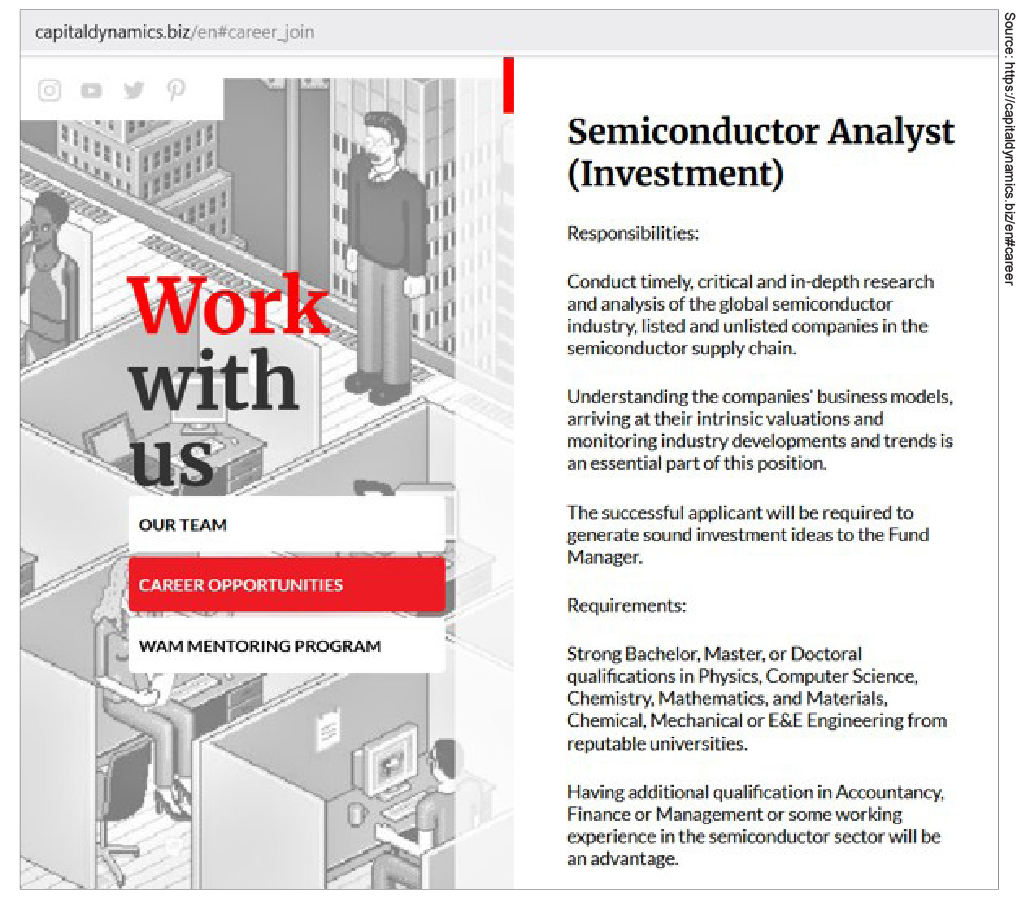
Source: https://capitaldynamics.biz/en#career
Source: Capital Dynamics
As part of our hiring, we seek individuals with strong academic backgrounds in fields such as Physics, Computer Science, Mathematics, Materials Sciences, Chemical Engineering and Electrical & Electronics Engineering — intellectually curious, analytically driven, hardworking and eager to apply their knowledge beyond the lab. If you aspire to build a career where science and technology meet investment, send us your resume. Referrals are welcomed.
- KL: careers@cdam.biz
- HK: careers@capitaldynamics.hk
- Shanghai: careers@capitaldynamics.cn.com
- Sydney: careers@capitaldynamics.com.au